


Money & Economics
- Thread starter bigredfish
- Start date
You are using an out of date browser. It may not display this or other websites correctly.
You should upgrade or use an alternative browser.
You should upgrade or use an alternative browser.


Well dang, gotta stop braggingWith all the Bad News here, wanted to share our surprise on our Auto Insurance renewal, no coverage difference either, actually they added a thing called Declining Deductible (no cost) where our deductibles drop $50 each year we renew/hold a continuous policy with them. Not sure the cap, maybe one day no deductible? Would be ok with us
This is a 6 month full coverage policy for a 2025 RAM 1500 and 2019 Highlander
View attachment 242099
I am going to call our Agent to see if we can renew for one year at this rate...I think though I asked before and they said no...(Yep just confirmed, they only do 6 month policies)
Oh, yes we have our Home and Auto bundled with same Ins. Co., FYI
UPDATE: Our Agent said the Declining Deductible is every 6 months and there is no cap. So $100 a year less deductible, pretty kewl. We have $500 deductibles so got 5 years to end up with zero deductible.
The Agent also said since we have had not incidents and we have been with them for a long time we are signed up for first accident will not go against us even if it is our fault. It has been a long time since we have been in one and now we are driving less than we did in the big city so our percentage chances are less, people drive much better out in the country than in the city. We get it is a promotional thing.
 Talked to an assistant today at our Ins. co. and found out our Home Owner's Ins. increased $200 for a year policy. So much for saving $200 on our Auto Ins. , but our Auto Ins. is a 6 month policy so if it remains the same on next renewal we will be ahead $200, but that is in Nov.
Here is our Home Owner history in our retirement home:
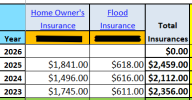
Really want to drop Flood Ins., we live on a small hill and no one we have talked to out here has Flood Ins., but every time the wife and I talk about doing so we bring up the Texas Hill Country floods even though we do not live in the Hill Country.
I guess we still can't complain, the year we sold our house, 2024, there was a $1500 increase on our Home Owner's Ins., talk about moving at the right time. Our family who still lives there said theirs is now double. The above premiums do cover three buildings here though so we need to take that into account. But dang, no mortgage, retired fix income and our highest bills we pay are for Insurance. (Home Owners, Vehicle, Health)

This Home Owner Ins. increase is like the SS increase that got eaten up with the Medicare increase, so basically no increase.
Have a phone appt. with Agent tomorrow to discuss Home policy. Hopefully, like in the pass, I can get it chewed down some...but that normally means less coverage.

I probably only have another 10-15 years, would like to fully understand it before I get “liquidated”!
Yes, I understand... 5-10 yeas here... liquidated, oh, shit

Good post to help get your head around bonds as far as buying/selling.
For those of us old fucks looking at Treasury's, Money Markets, High Yield Savings Accounts and fixed rate CDs as safe guaranteed investments, we like higher yields.
But in the bigger picture, higher yields mean increased borrowing costs. (Like mortgages that ticked back up today)
Higher borrowing costs also means the US .gov has to pay out more for holders of bonds (our creditors, who buy the bonds effectively loaning us money so we can spend more)
I’m still learning bonds, they influence much of our economy.
I’m learning that as kinda implied above, there are two ways to look at bonds. The simple yield which you and I care about for fixed rate investments, and the bond markets which by and large look at it the opposite way.
Because of this, it’s often hard for me to decipher news about the bond markets. Much of the news is therefore 180 degrees from my personal perspective.
The news today which made me go down the rabbit hole was “bond market is looking like it might crash”. But I see higher yields across the board.
I view that as good.!
But bond prices (what you pay for them, usually a discount to face value) are always opposite bond yields (what you get back if you hold to maturity)
So big guys sitting in bonds worth bazillions see their investment decrease when bond yields go up. Their “old” bonds are now worth less than the “new” bonds at higher yields and lower price.
I think I have that basically right.
Anyone ?
Just got a letter last week on an inherited IRA Muni bond that got Called. It was making over 7% non-taxable. Been depleting the inherited IRA account/bonds since my Dad passed in 2020, have 10 years to fully do so, was hoping this 7% bond would go a few more years...atleast got 5 years, while we owned it, at a good rate, it was a $20k bond.
One thing I learned about Bonds is they are sellable, in our case we had to sell some to deplete the inherited IRA, my Dad bought them when they were 5-7% so they are easily sold in today's market. So these Muni Bonds are like trying to sell brokage CDs. If the going interest rates are lower at the time of sell you do good, if higher you lose.
Just got this offer Tuesday, 28th

Those Maturity dates use to scare me but now that I understand these Munis are easily sellable so I ignore that date. Yield to Maturity % and Callable date is what I look at...so in summary this Muni Bond will pay 4.5% interest for the next 8 years, if Called, with tax free dividends twice a year, is what I normally see, sometimes quarterly.
HTH
But to add if your state has no tax on Muni Bonds then your return is even more. Not sure how this factors in if the buyer is from another state though, but that's on them.There's another way to look at this...
Because... this is a bit simplified (mainly because it does not take bond liquidity and potentially mismatched maturity dates into account), but essentially...
The investment value of a bond I currently own doesn't actually decrease when new bond yields go up... the value stays the same irrespective of how new bond yields move (up or down)!
For instance...
If I'm holding a bond that matures in 5 years (regardless of its original term or when I bought it) and new issue 5-year bonds are available at a higher yield, then if I want to sell my existing bond, I will have to do so a discount (lower price).
Now if I go and buy the new issue higher yield 5-year bond with the proceeds from the sale I just made, I will end up with a little bit less face amount than I had before, because I sold at a discount... but the new bond lower face amount and higher yield would theoretically offset each other and net to the value of the bond I had sold!
In other words, in 5 years I'll have the same bucks I would have had whether I kept the original bond or sold it and bought the new one.
Likewise, if I sell a bond at a premium (higher price) because current rates for the same maturity as my bond are lower, I will end up buying more face amount at lower yield when reinvesting... but net the same amount (value) at maturity.
My main point here is that bond "value" and "price" are not the same... notice if I ask Google, "do bond values go down if new yields go up?", the answer is "Yes, bond values (prices)" [are the same]...
View attachment 242803
Yet, if I ask Google, "are bond value and price the same?", the answer is "No, bond value and price are not the same"...
View attachment 242804
Tell me if I'm nuts!
This same principle holds true in Buying/Selling Brokerage CDs. Fidelity shows your Brokerage CDs value based on current selling rates and not full term rate. When we first bought our Brokerage CDs, and CD rates/prentages went up, we freaked when we saw what our CDs balances were
, of course this was the value we would of gotten if we sold at that time. Now they are all in the positive since CDs now sell at a good precent lower than when we bought. 
An example of who cares... this was 19 bucks 6 months ago...

You got you a Classic there...wish I had an older vehicle now...
Yeah, we are paying $50 a month per newer vehicle...Full coverage, $500 deducible.
tigerwillow1
Known around here
I had an '84 4000S FWD with the 4-banger. It was comfortable and easy to drive, and super reliable. It eventually went to one of my kids then the boneyeard after the wheels figuratively fell off. I've had a couple of newer Audis since. Nice cars when everything works, but they demand a steady diet of parts.
You got you a Classic there...wish I had an older vehicle now...
Yeah, we are paying $50 a month per newer vehicle...Full coverage, $500 deducible.
It's been sitting in the garage for quite a few years now.... I run it once in a blue moon just to keep the finicky fuel system clean... one of these years, somethings gonna clog up.
LOL
He’s not wrong ..
That's funny... reminds me of Big Mac parity (old fx)....
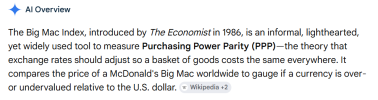
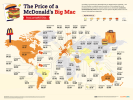
Speaking of Mickey D's, the wife and I get their Sausage Biscuit and Sausage McMuffin with a second one of each for a dollar to bring home to heat up the next morning. Or if we have our dogs with us, they each get one Cheap Breakfast.
Cheap Breakfast.
Peak gullibility
7 companies determine the stock market moves. 7
And they’re all AI driven with capex that makes any sane person blush and profitability estimates years out made by accounting teams who only get paid if the numbers sound good.
If you lived the 1999-2000 dot com market, you’re watching a rerun.
7 companies determine the stock market moves. 7
And they’re all AI driven with capex that makes any sane person blush and profitability estimates years out made by accounting teams who only get paid if the numbers sound good.
If you lived the 1999-2000 dot com market, you’re watching a rerun.


mat200
IPCT Contributor
- Jan 17, 2017
- 19,758
- 32,956
India Big Mac .. hmm .. I thought beef was holy in India ?
Something not fully adding up on this ..
mat200
IPCT Contributor
- Jan 17, 2017
- 19,758
- 32,956
The underlying game being played ..
The game involves a coordinated effort by Citadel and other high-profile entities to create a public threat of exiting New York to influence state tax policy, specifically targeting Zohran Mamdani's $1 billion tax proposal (1:48-2:24, 6:03-6:39). This strategy relies on misleading claims about abandoning massive development projects despite the fact that firm contracts and real estate commitments were already legally binding and in progress (10:07-11:26).
Hedge Fund CEOs ERUPT After Mamdani's $1 Billion New Tax SLAMS Wall Street
Omars Talk Show
This video investigates the narrative surrounding Citadel hedge fund's reaction to a tax proposal by New York City Mayor Zohran Mamdani. The video argues that the firm's widely reported threats to pull a $6 billion project from New York were a strategic "faint" rather than a genuine business decision.
Key takeaways:
The game involves a coordinated effort by Citadel and other high-profile entities to create a public threat of exiting New York to influence state tax policy, specifically targeting Zohran Mamdani's $1 billion tax proposal (1:48-2:24, 6:03-6:39). This strategy relies on misleading claims about abandoning massive development projects despite the fact that firm contracts and real estate commitments were already legally binding and in progress (10:07-11:26).
Hedge Fund CEOs ERUPT After Mamdani's $1 Billion New Tax SLAMS Wall Street
Omars Talk Show
This video investigates the narrative surrounding Citadel hedge fund's reaction to a tax proposal by New York City Mayor Zohran Mamdani. The video argues that the firm's widely reported threats to pull a $6 billion project from New York were a strategic "faint" rather than a genuine business decision.
Key takeaways:
- The Trigger: On April 15, 2026, Zohran Mamdani filmed a video outside Ken Griffin's penthouse, calling for higher taxes on the wealthy (1:48-2:24).
- The Email: Eight days later, Citadel COO Gerald Beon sent an email—widely leaked to the press—stating that the firm's $6 billion project at 350 Park Avenue would only proceed if specific conditions were met. The implication was that Citadel would abandon the project if taxed further (2:26-3:04).
- The Fact Check: The video provides evidence that Citadel had already signed a master lease for 350 Park Avenue with a $36 million annual rent obligation (10:07-11:04). Therefore, the "if we move forward" language in the email was structurally misleading, as the firm was already legally committed to the project (10:49-11:26).
- Contradictory Behavior: The video highlights that Ken Griffin continued to make massive real estate acquisitions in New York, such as a $38 million cash purchase at 740 Park Avenue, just weeks before the tax video was posted (7:49-8:30).
- Broader Implications: The creator suggests this is part of a larger, coordinated playbook used by billionaire executives in high-tax states like Illinois and California to influence budget negotiations (13:27-14:52).
Foreclosure filings jump to six-year high as rising property taxes, insurance costs and debt strain U.S. homeowners

How does overbuilding cause inability to pay the mortgage?
Anyhow, markets get imbalanced by government interference, not free market decisions.
Anyhow, markets get imbalanced by government interference, not free market decisions.
How does overbuilding cause inability to pay the mortgage?
Anyhow, markets get imbalanced by government interference, not free market decisions.
Re: overbuilding. I don’t think this piece says that.
That said, Overbuilding is a lagging effect, happens after the main rush, expecting it to continue. That’s part of what’s driving price reductions here in Florida. New homes are starting to sell for less than existing as builders offer discounts to get rid of the excess inventory, driving everything down.
Agree on .gov market interference but good old fashioned greed plays a major role today. Many moved here (2020-2025 boom) as they saw prices skyrocketing in hopes that would continue. Builders ramped up anticipating same.
The author of this piece describes costs beyond the home price as driving much of the deflating balloon. (Taxes, insurance, maintenance, etc). They were already stretched when they bought at the top, then these other costs kicked in and drove them over the edge as they were already living beyond their means to begin with.
Add 3% mortgages to that when bought and now avg is 6.5% and, along with very little equity, they’re stuck.
Last edited: