


Money & Economics
- Thread starter bigredfish
- Start date
You are using an out of date browser. It may not display this or other websites correctly.
You should upgrade or use an alternative browser.
You should upgrade or use an alternative browser.


I’m not kidding with my signature
Jamie Dimon today: "The way it's going now, there will be some kind of bond crisis."
He added that when a credit recession hits across all lending, it will be "worse than people think. It might be terrible."
This is the CEO of the world's largest bank.
Nothing to see here...
Jamie Dimon today: "The way it's going now, there will be some kind of bond crisis."
He added that when a credit recession hits across all lending, it will be "worse than people think. It might be terrible."
This is the CEO of the world's largest bank.
Nothing to see here...

Paul Tudor Jones says the US is more dependent on equity prices than ever, and explains what a 35% correction would trigger in the economy:
"We're 252% of stock market cap to GDP. In 1929 we were 65%. In 1987 we got to ~85-90%. In 2000, 170%.
If you think about the periodicity of significant bear markets. Since 1970, we get a mean reversion about every 10 years.
Let's say mean revert to the past 25 or 30-year PE. That would be a 30, 35% decline. Well, 35% on 250% of GDP is 80, 90% of GDP.
10% of our tax revenues are capital gains, they go to zero. So you can see the budget deficit blowing up. You can see the bond market getting smoked. You can see this kind of negative self-reinforcing effect.
In the stock market, we're over-equitized as a country. We have the highest individual equity weightings in the history of the country.
And then the real problem is if you look at private equity in 2007-2008, that was about 7% of institutional portfolios. Now it's about 16% of the institutional portfolios. We're so much more illiquid than we were in 2008.
The problem is that if you buy the S&P at this current valuation, the 10-year forward return is negative when you buy the S&P with a PE of 22. That's what history shows.
So yes, the S&P is spectacular long-term, if you have a hundred-year view. But that's because that's an average of a hundred years, including times when the S&P 500 PE was 6, 7 and 8, or one third of what it is right now.
Valuation matters a lot, and the stock market's really high and it's gonna be really hard to make money from here with any kind of long-term view."
"We're 252% of stock market cap to GDP. In 1929 we were 65%. In 1987 we got to ~85-90%. In 2000, 170%.
If you think about the periodicity of significant bear markets. Since 1970, we get a mean reversion about every 10 years.
Let's say mean revert to the past 25 or 30-year PE. That would be a 30, 35% decline. Well, 35% on 250% of GDP is 80, 90% of GDP.
10% of our tax revenues are capital gains, they go to zero. So you can see the budget deficit blowing up. You can see the bond market getting smoked. You can see this kind of negative self-reinforcing effect.
In the stock market, we're over-equitized as a country. We have the highest individual equity weightings in the history of the country.
And then the real problem is if you look at private equity in 2007-2008, that was about 7% of institutional portfolios. Now it's about 16% of the institutional portfolios. We're so much more illiquid than we were in 2008.
The problem is that if you buy the S&P at this current valuation, the 10-year forward return is negative when you buy the S&P with a PE of 22. That's what history shows.
So yes, the S&P is spectacular long-term, if you have a hundred-year view. But that's because that's an average of a hundred years, including times when the S&P 500 PE was 6, 7 and 8, or one third of what it is right now.
Valuation matters a lot, and the stock market's really high and it's gonna be really hard to make money from here with any kind of long-term view."
Quite simply this.
FLORIDA: If you’re still holding out hope that your McMansion will net you that ridiculous $500k profit and are counting that equity as a large part of your net worth, you’d better hope you live long enough to see it.
If on the other hand you’re simply looking to pass the house down to your kids, well…you better hope you DON’T live that long
Yes, you’re trapped.
FLORIDA: If you’re still holding out hope that your McMansion will net you that ridiculous $500k profit and are counting that equity as a large part of your net worth, you’d better hope you live long enough to see it.
If on the other hand you’re simply looking to pass the house down to your kids, well…you better hope you DON’T live that long
Yes, you’re trapped.
Last edited:

mat200
IPCT Contributor
- Jan 17, 2017
- 19,758
- 32,956
Not surprising
and yet the prices are crazy high compared to 2012, 2018 ..

Yup.
They have no choice.
The explosion in stupid valuation, (just like the stock market), over the past 5 Covid years has everyone with a 3% mortgage and leveraged to the gills, depending on that 200% growth to continue. It fed their lavish lifestyle and spending.
Now the bills are coming due and many can’t afford to take the loss. They’ll hold on as long as they can.
But the cracks are getting bigger. Gravity will eventually win.
Wifey has an uncle (great guy but not the sharpest crayon in the box) who bought at the top in 2022, trailer in a very nice neighborhood, on the saltwater in Bradenton. $200k. 15 yr mortgage.
After the Hurricane in Fall of 2024 where he got some minor flooding, they decided to move back north and put it up for sale for $259,000 early last year (2025) I told him to lower it to $199k and be happy if he gets it.
His agent is now selling same units in same neighborhood at $140k.
Hes dropped his price to $175k and wonders why it hasn’t sold. He’s either stuck with it or facing a possible 50% loss.
They have no choice.
The explosion in stupid valuation, (just like the stock market), over the past 5 Covid years has everyone with a 3% mortgage and leveraged to the gills, depending on that 200% growth to continue. It fed their lavish lifestyle and spending.
Now the bills are coming due and many can’t afford to take the loss. They’ll hold on as long as they can.
But the cracks are getting bigger. Gravity will eventually win.
Wifey has an uncle (great guy but not the sharpest crayon in the box) who bought at the top in 2022, trailer in a very nice neighborhood, on the saltwater in Bradenton. $200k. 15 yr mortgage.
After the Hurricane in Fall of 2024 where he got some minor flooding, they decided to move back north and put it up for sale for $259,000 early last year (2025)
I told him to lower it to $199k and be happy if he gets it.His agent is now selling same units in same neighborhood at $140k.
Hes dropped his price to $175k and wonders why it hasn’t sold. He’s either stuck with it or facing a possible 50% loss.

mat200
IPCT Contributor
- Jan 17, 2017
- 19,758
- 32,956
Rut Ro
btw - this is "old news" .. analysis of this was out iirc about 1 month ago ..


Good post to help get your head around bonds as far as buying/selling.
For those of us old fucks looking at Treasury's, Money Markets, High Yield Savings Accounts and fixed rate CDs as safe guaranteed investments, we like higher yields.
But in the bigger picture, higher yields mean increased borrowing costs. (Like mortgages that ticked back up today)
Higher borrowing costs also means the US .gov has to pay out more for holders of bonds (our creditors, who buy the bonds effectively loaning us money so we can spend more)
I’m still learning bonds, they influence much of our economy.
I’m learning that as kinda implied above, there are two ways to look at bonds. The simple yield which you and I care about for fixed rate investments, and the bond markets which by and large look at it the opposite way.
Because of this, it’s often hard for me to decipher news about the bond markets. Much of the news is therefore 180 degrees from my personal perspective.
The news today which made me go down the rabbit hole was “bond market is looking like it might crash”. But I see higher yields across the board.
I view that as good.!
But bond prices (what you pay for them, usually a discount to face value) are always opposite bond yields (what you get back if you hold to maturity)
So big guys sitting in bonds worth bazillions see their investment decrease when bond yields go up. Their “old” bonds are now worth less than the “new” bonds at higher yields and lower price.
I think I have that basically right.
Anyone ?
For those of us old fucks looking at Treasury's, Money Markets, High Yield Savings Accounts and fixed rate CDs as safe guaranteed investments, we like higher yields.
But in the bigger picture, higher yields mean increased borrowing costs. (Like mortgages that ticked back up today)
Higher borrowing costs also means the US .gov has to pay out more for holders of bonds (our creditors, who buy the bonds effectively loaning us money so we can spend more)
I’m still learning bonds, they influence much of our economy.
I’m learning that as kinda implied above, there are two ways to look at bonds. The simple yield which you and I care about for fixed rate investments, and the bond markets which by and large look at it the opposite way.
Because of this, it’s often hard for me to decipher news about the bond markets. Much of the news is therefore 180 degrees from my personal perspective.
The news today which made me go down the rabbit hole was “bond market is looking like it might crash”. But I see higher yields across the board.
I view that as good.!
But bond prices (what you pay for them, usually a discount to face value) are always opposite bond yields (what you get back if you hold to maturity)
So big guys sitting in bonds worth bazillions see their investment decrease when bond yields go up. Their “old” bonds are now worth less than the “new” bonds at higher yields and lower price.
I think I have that basically right.
Anyone ?
Last edited:
There's another way to look at this...
Because... this is a bit simplified (mainly because it does not take bond liquidity and potentially mismatched maturity dates into account), but essentially...
The investment value of a bond I currently own doesn't actually decrease when new bond yields go up... the value stays the same irrespective of how new bond yields move (up or down)!
For instance...
If I'm holding a bond that matures in 5 years (regardless of its original term or when I bought it) and new issue 5-year bonds are available at a higher yield, then if I want to sell my existing bond, I will have to do so a discount (lower price).
Now if I go and buy the new issue higher yield 5-year bond with the proceeds from the sale I just made, I will end up with a little bit less face amount than I had before, because I sold at a discount... but the new bond lower face amount and higher yield would theoretically offset each other and net to the value of the bond I had sold!
In other words, in 5 years I'll have the same bucks I would have had whether I kept the original bond or sold it and bought the new one.
Likewise, if I sell a bond at a premium (higher price) because current rates for the same maturity as my bond are lower, I will end up buying more face amount at lower yield when reinvesting... but net the same amount (value) at maturity.
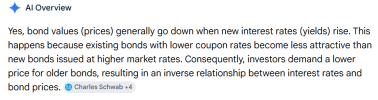
My main point here is that bond "value" and "price" are not the same... notice if I ask Google, "do bond values go down if new yields go up?", the answer is "Yes, bond values (prices)" [are the same]...
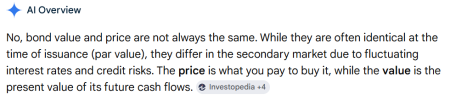
Yet, if I ask Google, "are bond value and price the same?", the answer is "No, bond value and price are not the same"...
Tell me if I'm nuts!
So big guys sitting in bonds worth bazillions see their investment decrease when bond yields go up.
Because... this is a bit simplified (mainly because it does not take bond liquidity and potentially mismatched maturity dates into account), but essentially...
The investment value of a bond I currently own doesn't actually decrease when new bond yields go up... the value stays the same irrespective of how new bond yields move (up or down)!
For instance...
If I'm holding a bond that matures in 5 years (regardless of its original term or when I bought it) and new issue 5-year bonds are available at a higher yield, then if I want to sell my existing bond, I will have to do so a discount (lower price).
Now if I go and buy the new issue higher yield 5-year bond with the proceeds from the sale I just made, I will end up with a little bit less face amount than I had before, because I sold at a discount... but the new bond lower face amount and higher yield would theoretically offset each other and net to the value of the bond I had sold!
In other words, in 5 years I'll have the same bucks I would have had whether I kept the original bond or sold it and bought the new one.
Likewise, if I sell a bond at a premium (higher price) because current rates for the same maturity as my bond are lower, I will end up buying more face amount at lower yield when reinvesting... but net the same amount (value) at maturity.
My main point here is that bond "value" and "price" are not the same... notice if I ask Google, "do bond values go down if new yields go up?", the answer is "Yes, bond values (prices)" [are the same]...
Yet, if I ask Google, "are bond value and price the same?", the answer is "No, bond value and price are not the same"...
Tell me if I'm nuts!
There's another way to look at this...
Because... this is a bit simplified (mainly because it does not take bond liquidity and potentially mismatched maturity dates into account), but essentially...
The investment value of a bond I currently own doesn't actually decrease when new bond yields go up... the value stays the same irrespective of how new bond yields move (up or down)!
For instance...
If I'm holding a bond that matures in 5 years (regardless of its original term or when I bought it) and new issue 5-year bonds are available at a higher yield, then if I want to sell my existing bond, I will have to do so a discount (lower price).
Now if I go and buy the new issue higher yield 5-year bond with the proceeds from the sale I just made, I will end up with a little bit less face amount than I had before, because I sold at a discount... but the new bond lower face amount and higher yield would theoretically offset each other and net to the value of the bond I had sold!
In other words, in 5 years I'll have the same bucks I would have had whether I kept the original bond or sold it and bought the new one.
Likewise, if I sell a bond at a premium (higher price) because current rates for the same maturity as my bond are lower, I will end up buying more face amount at lower yield when reinvesting... but net the same amount (value) at maturity.
My main point here is that bond "value" and "price" are not the same... notice if I ask Google, "do bond values go down if new yields go up?", the answer is "Yes, bond values (prices)" [are the same]...
View attachment 242803
Yet, if I ask Google, "are bond value and price the same?", the answer is "No, bond value and price are not the same"...
View attachment 242804
Tell me if I'm nuts!
Thanks, that’s a better explanation, yes I think we’re saying the same, from a buy and hold to maturity perspective.
There’s a difference in perspective when you’re actively trading bonds on a daily basis at high volume.
And I do get the inverse of price vs yield.
I know that .gov is watching the 10yr closely and start to get jittery when it passes 4.5% yield. And the 30yr broke through 5% yesterday
Ultimately the higher yields mean we’re (.Gov) having to pay a bigger premium for people to buy our paper IOU. And as yields keep increasing (>5%), it also starts to effect equities as folks think “hey why take the risk for 6-8% when I can sleep better at a guaranteed 5%+”
It’s a very complicated casino! I probably only have another 10-15 years, would like to fully understand it before I get “liquidated”!