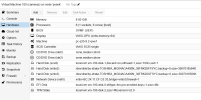
Blue Iris in a VM.

I haven't yet checked the power settings in Windows - so I am unsure what power profile it was running in the above test.

I suppose this could help reduce the consumption a little, but I am not familiar with power management settings in Proxmox / Debian, so not sure if I would be able to make use of this if running PVE anyway...
 
And sorry to write so many posts, but another thing I just thought of - what about swapping the Xeon E5-1630 in the box currently for something more moderate / efficient, with the same socket?

For example maybe a Xeon E5-2630L v3 - TDP only 55w, slower clock speed than the E5-1630, but 4 more cores - and I understand BI can make use of multiple cores, to might not be a bad thing... The 2630's seem to be going quite cheap online. Comparison.
 
Yes Blue Iris can use multiple cores pretty effectively but you lose quite a lot of single thread performance going to that lower TDP part and that will likely make certain tasks like web streaming 4K video suffer -- BI is already not great at that if you aren't using direct-to-wire.

Check the difference in power consumption of the E5-1630 at idle versus under a significant load (e.g. running a CPU benchmark like Prime95). You can also run hwinfo to see an estimate of the amount of power certain components are using (CPU, GPU in particular). That should tell you more about how much of the idle load is what.

You can still build around an N305 for example and have 6 SATA slots, but expandability is severely limited, only one DDR5 SODIMM slot for example.

You are probably better off going with a more powerful desktop platform like an Intel Core Ultra 5 225 or Ryzen 5 9600X. Comparison: Intel Xeon E5-1630 v3 vs i3-N305 vs Xeon E5-2630L v3 vs Ultra 5 225 vs AMD Ryzen 5 9600X [cpubenchmark.net] by PassMark Software
Then you get vastly higher single threaded performance and dual channel memory and a PCI-E slot or two that could run a GPU, faster network adapter, etc.

And we can't forget what has happened to RAM prices in the last few months, which certainly makes older server systems look more favorable. Just buying 32-64 GB of RAM could take years to pay for itself in energy savings from using a newer platform.
 
Thanks again for the helpful responses!

I left the E5-1630 machine running a while, and then came back to check the power consumption (I wondered if before Windows may have been doing some post-startup 'stuff'). Anyway it had certainly stabilized to about 80-85w at the PDU, with the CPU at idle, 2 SSD's powered up (no HDD, I was mistaken), and the Nvidia Quadro 4000 running at idle.

I installed Open Hardware Monitor, and CPU-Z, and inspected some of the more detailed power stats, at idle and then at 100% with a CPU-Z stress test running. The strange thing is, at idle, OHM was only reporting about 8w for the CPU Package, which seems quite low - where is all that 80w being consumed?

I did notice (only remembered to take a photo when the stress test was running, not at idle), that OHM seems to fail to report any value for CPU Cores - so I do wonder if this could be what is consuming the power, and OHM is just failing to read properly?

20251210_160637.jpg
** Notice the 0.0W for CPU Cores **

I think the system was drawing about 150w measured at the PDU when under full load, from memory.

You are probably better off going with a more powerful desktop platform like an Intel Core Ultra 5 225 or Ryzen 5 9600X. Comparison: Intel Xeon E5-1630 v3 vs i3-N305 vs Xeon E5-2630L v3 vs Ultra 5 225 vs AMD Ryzen 5 9600X [cpubenchmark.net] by PassMark Software
Then you get vastly higher single threaded performance and dual channel memory and a PCI-E slot or two that could run a GPU, faster network adapter, etc.
The other thing to consider, in addition to @bp2008 comment about RAM prices, is that I got this system free. Whilst the above mentioned desktop-style systems would likely be better, by the time I have paid for a system like this, vs using this surplus server I got for nothing, it may be worth using the less efficient system...

And if I could run some other VM's on the same hardware in addition to BI, I may be able to make the system pay for itself in other ways. Including replacing some of the other bare metal systems I have running at the moment, somewhat cancelling out the increased power cost.

 
Right by the time you buy something more efficient and calculate it out it might be years before you actually get the $$ back from saved electricity usage. I'm in the same boat. My sans is costing me ~$25-30 a month in electricity, but if I bought bigger drives for my server I could get rid of the sans. But even buying used drives it would be take me a year to recoup the cost at $25/ month. The return is not really worth the hassle.