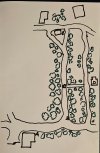
Hi all. Need some guidance here please. I've been charged with setting up 3 surveillance zones in a heavily wooded campground --- a "home" zone at the camp store/office, and 2 remote zones monitoring several buildings 500 ft away and 700 feet away respectively. The remotes will have 5 and 6 indoor & outdoor cameras, most PoE/some wifi+solar in each zone. Hoping to utilize an NVR to collect each remote zone's feeds and then ALSO to also transmit each of those 2 remote zone feeds back to the office zone using bridges.
Because of trees, I'll have to relay the bridge zones but 2 of the relay points won't have access to 120v power, nor will the tree canopies allow for a solar panel/battery/inverter to provide power. Any ideas from you fine folks?
The best way I can describe my proposed layout is as follows :
Bridge jump #1 : Store to Pole #1 (~60 yards clear line of sight but no power)
Bridge jump #2 : Pole #1 to Pole #2 (~80 yards clear LOS, but no power)
Bridge jump #3 : Pole #2 to Remote Zone 2 (~50 yards clear LOS, has power available)
Bridge jump #4 : Pole #2 to Remote Zone 3 (~80 yards clear LOS, has power available)
Am I able to "push" power from the store to pole #1 using a PoE injector?
Am I able to "push" power from either (or both) remote zone buildings to pole #2 using a PoE injector?
Any other special hardware needed to achieve this other than outdoor PoE switches on each jump end? Can I use ONE switch on pole # 2 to power and xfer signals from all three jumps connected to that pole? Wanting to utilize our store's Starlink Gen 3 for all wifi coverage too, so not sure on what special hardware needed (I've seen a Starlink Gen 3 Ethernet Adapter being needed?). Sorry, so many questions and can't quite find an answer anywhere online for my unique situation.
Final question : am I able to gather the many camera feeds into ONE NVR at the store (store will have 7 cams, zone 2 = 5 cams, zone 3 = 6 cams), or will I be better off using an NVR at each zone? Boss wants to be able to pull up any camera on his phone so was hoping to gather ALL feeds into one place for him to access. He'd prefer Reolink hardware so have been building a shopping list of cams and NVRs to look at. Any assistance GREATLY appreciated.
Cheers all, Mike
Because of trees, I'll have to relay the bridge zones but 2 of the relay points won't have access to 120v power, nor will the tree canopies allow for a solar panel/battery/inverter to provide power. Any ideas from you fine folks?
The best way I can describe my proposed layout is as follows :
Bridge jump #1 : Store to Pole #1 (~60 yards clear line of sight but no power)
Bridge jump #2 : Pole #1 to Pole #2 (~80 yards clear LOS, but no power)
Bridge jump #3 : Pole #2 to Remote Zone 2 (~50 yards clear LOS, has power available)
Bridge jump #4 : Pole #2 to Remote Zone 3 (~80 yards clear LOS, has power available)
Am I able to "push" power from the store to pole #1 using a PoE injector?
Am I able to "push" power from either (or both) remote zone buildings to pole #2 using a PoE injector?
Any other special hardware needed to achieve this other than outdoor PoE switches on each jump end? Can I use ONE switch on pole # 2 to power and xfer signals from all three jumps connected to that pole? Wanting to utilize our store's Starlink Gen 3 for all wifi coverage too, so not sure on what special hardware needed (I've seen a Starlink Gen 3 Ethernet Adapter being needed?). Sorry, so many questions and can't quite find an answer anywhere online for my unique situation.
Final question : am I able to gather the many camera feeds into ONE NVR at the store (store will have 7 cams, zone 2 = 5 cams, zone 3 = 6 cams), or will I be better off using an NVR at each zone? Boss wants to be able to pull up any camera on his phone so was hoping to gather ALL feeds into one place for him to access. He'd prefer Reolink hardware so have been building a shopping list of cams and NVRs to look at. Any assistance GREATLY appreciated.
Cheers all, Mike