
WizColor 2.0 is coming (15 April)
- Thread starter steve1225
- Start date

You are using an out of date browser. It may not display this or other websites correctly.
You should upgrade or use an alternative browser.
You should upgrade or use an alternative browser.


the most beautiful powerful camera like the world has never seen before (available exclusively in gold finish)
tmxv4128
Getting comfortable
"Maximum sensitivity, thinnest on the market, and providing reliable protection." You are talking cameras, right?Pro Ultra X.

CCTVCam
Known around here
- Sep 25, 2017
- 3,242
- 4,186
Not holding my breath. No amount of tricks can make up for a small sensor.

That's what she said.No amount of tricks can make up for a small sensor.
EMPIRETECANDY
IPCT Vendor

And the winner is: PRO X series with WizColor X technology 
Found on Dahua WebSite - there is new 2449-PROX, which probably have cheaper chips inside (less RAM or something)...
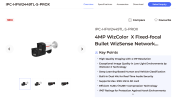
Found on Dahua WebSite - there is new 2449-PROX, which probably have cheaper chips inside (less RAM or something)...
Interesting: there is also 2249-PROX with 2 Mpx sensor in 1/1.8" !!!



bigredfish
Known around here
PRO Ultimate
Unless the sensor is better, it's all smoke and mirrors for the naive
Unless the sensor is better, it's all smoke and mirrors for the naive


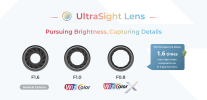


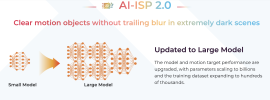
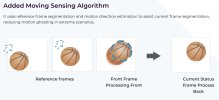

WizColor 2.0 (aka WizColor X) new features:
- bigger aperture F0.8 (I don't know how this even works). Asked gemini AI for commenting that aperture. Depth of Field (DoF) will be very problematic...
- bigger pixel size - but only for 2Mpx in 1/1.8" sensor...
- better AI-ISP 2.0 processing (bigger AI network),
- some previous / next video frame movement processing...
There will be new TIOC PRO camera models (3x59-PROX) and cheap plastic white only (no IR) 2x59-PROX models...
- bigger aperture F0.8 (I don't know how this even works). Asked gemini AI for commenting that aperture. Depth of Field (DoF) will be very problematic...
An f/0.8 aperture is an extreme feat of optical engineering. To understand how it works, you have to look at it as a ratio of light-gathering "hunger" versus the physical size of the lens.
In photography, the "f-number" is a mathematical fraction:
f-number=diameter of entrance pupilfocal length
For a lens to be f/0.8, the opening that lets light in (the entrance pupil) must actually be larger than the focal length of the lens itself. If you have a 50mm lens at f/0.8, the "hole" letting light in is a massive 62.5mm wide.
1. The Physics: How it Gathers Light
An f/0.8 aperture works by bending light at extremely steep angles to cram as many photons as possible onto the sensor.
- The Light Torrent: Compared to a "pro" f/2.8 lens, an f/0.8 lens lets in about 12 times more light. This allows you to shoot in near-total darkness without needing a flash.
- The f/0.5 Limit: In physics, the theoretical limit for a lens in air is f/0.5. As you get closer to this number, the light rays have to bend so sharply that they eventually reflect off the glass instead of going through it. An f/0.8lens is operating right at the edge of what’s physically possible.
2. The Result: "Paper-Thin" Focus
The most dramatic effect of f/0.8 is the Depth of Field (DOF). Because the light is coming from such a wide "eye," the plane of sharp focus is incredibly narrow.
- The Eyelash Problem: If you take a portrait at f/0.8, you might have the subject's iris in focus while their eyelashes and ears are already a blurry mess.
- Bokeh: The background blur is creamy and "painterly" because the out-of-focus light points (circles of confusion) are physically huge.
- bigger pixel size - but only for 2Mpx in 1/1.8" sensor...
- better AI-ISP 2.0 processing (bigger AI network),
- some previous / next video frame movement processing...
There will be new TIOC PRO camera models (3x59-PROX) and cheap plastic white only (no IR) 2x59-PROX models...
Last edited:
Sounds promising, but if the firmware behaves like Reolink, it is useless to most of us here.
The 2MP on 1/1.8" sensor will be interesting.
The 2MP on 1/1.8" sensor will be interesting.
alekk
Getting comfortable
The 2MP on 1/1.8" sensor will be interesting.
Ditto assuming that the 2MP are over the "entire" 1/1..8" sensor ... which seems consistent with the claim of larger pixel size.
Also ditto what @steve1225 said that F/0.8 is impressive for light gathering ... but DoF could be an issue, especially at even moderate zoom lengths. In the camera world, that's a "portrait" lens to isolate the subject.
bigredfish
Known around here
alekk
Getting comfortable
Ooops ... my wording was confusing as it sounds like I think it's varifocal ... but yea, I realize it's fixed focal ... just pointing out for any moderate zoom length fixed lens, DoF could be an issue. So main application may be an "area" camera with wide-angle lens with decent light gathering.
I didn't see anything about new/improved sensor technology ...
I didn't see anything about new/improved sensor technology ...
bigredfish
Known around here
Until we see a sample, an actual test against a known camera (5442?) in low light, with humans moving....

Until we see a sample, an actual test against a known camera (5442?) in low light, with humans moving....
View attachment 241957
Yep I am still waiting for the 4MTL example.....

Chokolinho
Known around here
Mine is supposed to arrive tomorrow.Yep I am still waiting for the 4MTL example.....
alekk
Getting comfortable
Does highlight "reduced motion blur", especially at the end.
But yes, we'll need to see some real-life examples ... and ideally side-by-side against the 5442 and the PRO ... so see how "good" this is.
But yes, we'll need to see some real-life examples ... and ideally side-by-side against the 5442 and the PRO ... so see how "good" this is.