Senate votes on ACA fail, threatening a rise in healthcare costs for everyone
Republican and Democratic lawmakers failed to advance a pair of stopgap plans in the Senate that would address the expiring Obamacare subsidies

www.marketwatch.com
Key Points
About This Summary
- Senate failure to pass stopgap plans for expiring Obamacare subsidies potentially leaves millions uninsured in 2026.
- ACA marketplace plan premiums are projected to increase by 114% on average in 2026 due to expiring tax credits and insurer rate hikes.
- The Urban Institute predicts 4.8 million people with 2025 ACA plans will be uninsured in 2026, reversing a decline in uninsured rates.
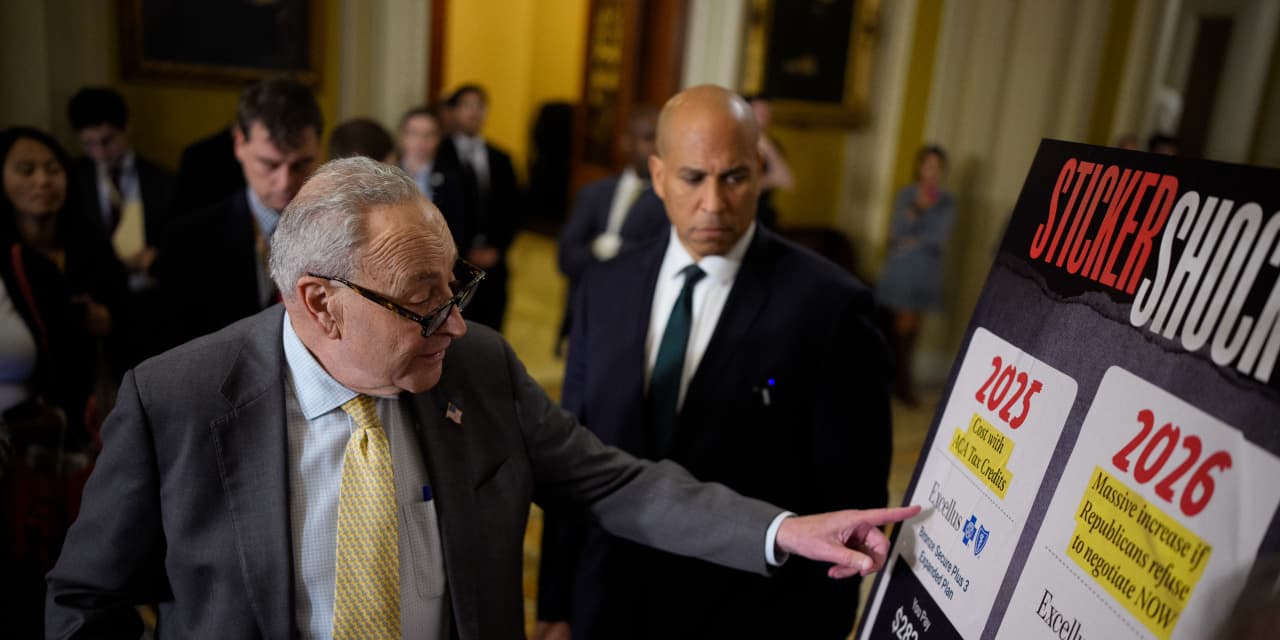
A pair of stopgap plans crafted to address expiring Obamacare subsidies failed in the Senate on Thursday, increasing the likelihood that millions of people in the U.S. will either go without health insurance next year or downgrade their coverage — leading to higher healthcare costs for most Americans.
The premiums for Affordable Care Act marketplace plans are going up by
114% on average in 2026 for two reasons: The enhanced tax credits that made those plans far more affordable expire Jan. 1, and health insurers pre-emptively raised rates with the expectation that millions of healthier, younger adults will opt out of coverage altogether as a result of the far more expensive monthly premiums.
“It quite plainly means less coverage,” said Jonathan Oberlander, professor of health policy and management at the University of North Carolina at Chapel Hill. “It’s not the holiday gift that most Americans are looking for, but you’re talking about — in the midst of an economy that’s experiencing substantial affordability challenges — on average doubling people’s premium payments in the marketplace.”
Premiums are not the only cost that is increasing. Deductibles are also going up, with some individuals taking on ones of $11,000 or even higher. The Urban Institute predicts that
4.8 million people who had an ACA marketplace plan in 2025 will be uninsured in 2026, the logic being if you’re relatively healthy, why pay for a plan that costs many hundreds of dollars per month and has a $10,000 deductible?
But for the system as a whole, accounting for more uninsured people will have a ripple effect. If some 4.8 million people are forced to go without health insurance, it would end the steady decline in the rate of uninsured people since 2011, when the ACA went into effect. It also means that healthcare costs will likely go up across the board, even for people who get their health insurance through an employer.
Health insurance costs are already rising — including for people
with employer plans and for
Medicare beneficiaries — driven by higher spending on prescription drugs like GLP-1s, providers charging higher prices for medical care and less competition among hospitals.
“Even though the impacts of the premium increases are confined to this one population of ACA enrollees, the effects on the health system will impact everybody at some point,” said Emma Wager, senior policy analyst for KFF’s Program on the ACA.
When people are uninsured, they often skip basic medical care like getting checkups and filling prescriptions, but they’re more likely to end up in an emergency room or hospital, which won’t be paid to care for them. Those providers will eventually raise their rates, affecting everyone who interacts with that health system.
Hospitals are already preparing for an influx of uninsured patients. New York City Health + Hospitals, a regional network of hospitals and nursing homes, may “revisit its cost-cutting plans” as it prepares for a “growing uninsured population.” It expects 150,000 people will lose coverage in its Essential Plan next year.
----------------
The majority of people in the U.S. have had health insurance coverage in recent years,
largely driven by the 2021 tax credits, which led to record participation in the marketplace. About 24.3 million people had an Obamacare plan in 2025, up from 11.4 million in 2020,
according to KFF — and about 22 million benefited from the subsidies. But the Affordable Care Act, President Barack Obama’s signature legislation, has long been a target for Republicans, who argue the system it created was overly reliant on increasing federal subsidies and that it sparked an explosion in healthcare costs. The question of whether to renew federal subsidies
was a sticking point in the government shutdown earlier this year.




 nypost.com