
PoE cable routing in Australian homes

SMarket

n3wb
Dec 8, 2025
5
7
Australia
Done a few AU installs recently, figured I'd share since most guides online are US-focused and miss some stuff that matters here.

House type determines your whole approach:

Brick veneer: drill into mortar joints, not the brick face.
1778654157585.png

Double brick / weatherboard: no internal cavity. External conduit the entire run — 20-25mm rigid UV-rated PVC, IP66 glands, silicone every wall entry.

Two-storey: ground-floor cameras always go external regardless of construction.


AU-specific gotchas:

1778654334537.png


Possums will chew raw Cat6 in the roof within weeks. Use rigid conduit or HDPE, steel mesh at entry points.

Roof cavity hits 50°C+ by 11am in summer. Do roof work early morning only.

CCA cable fails faster here — heat cycles + higher resistance. Solid copper Cat6 only.

Always drip loops. Storm season will push water straight into the pigtail.

Concealed runs technically fall under AS/CA S009:2020 — not enforced for private residential, but relevant for insurance.

Cable tester before the camera goes up. Re-terminating on the wall is miserable.

I wrote a longer version on our site if anyone wants to see the actual cable runs through an AU roof cavity.

What house type are you working with?

Happy to discuss any specific questions about PoE camera installs below!
 
A pretty fair write up, all except 3.H drip loop, No way i'd accept that install!
Yeah agree, drip loop on its own won't hold up in a proper southerly buster — needs a sealed IP67 box or self-amalgamating tape over the joint to do the job properly. Still a handy tip for the DIY crowd though, costs nothing to chuck in an extra bend as a backup.
 
  • Like
Reactions: Valiant
Any pictures of this UV-rated PVC external conduit you installed or mention often..."For ALL external runs; use grey/black UV-rated" and (Scenario C.... "Framing is fully enclosed. All cable runs must be external conduit."

How are you able to pull CAT cable out of a box, not off a reel, by yourself and not get twists and kinks....that would be a trick I'm interested in knowing.
 
Last edited:
Excerpt from Andersen Corp, a fiber optic manufacturer in Australia:

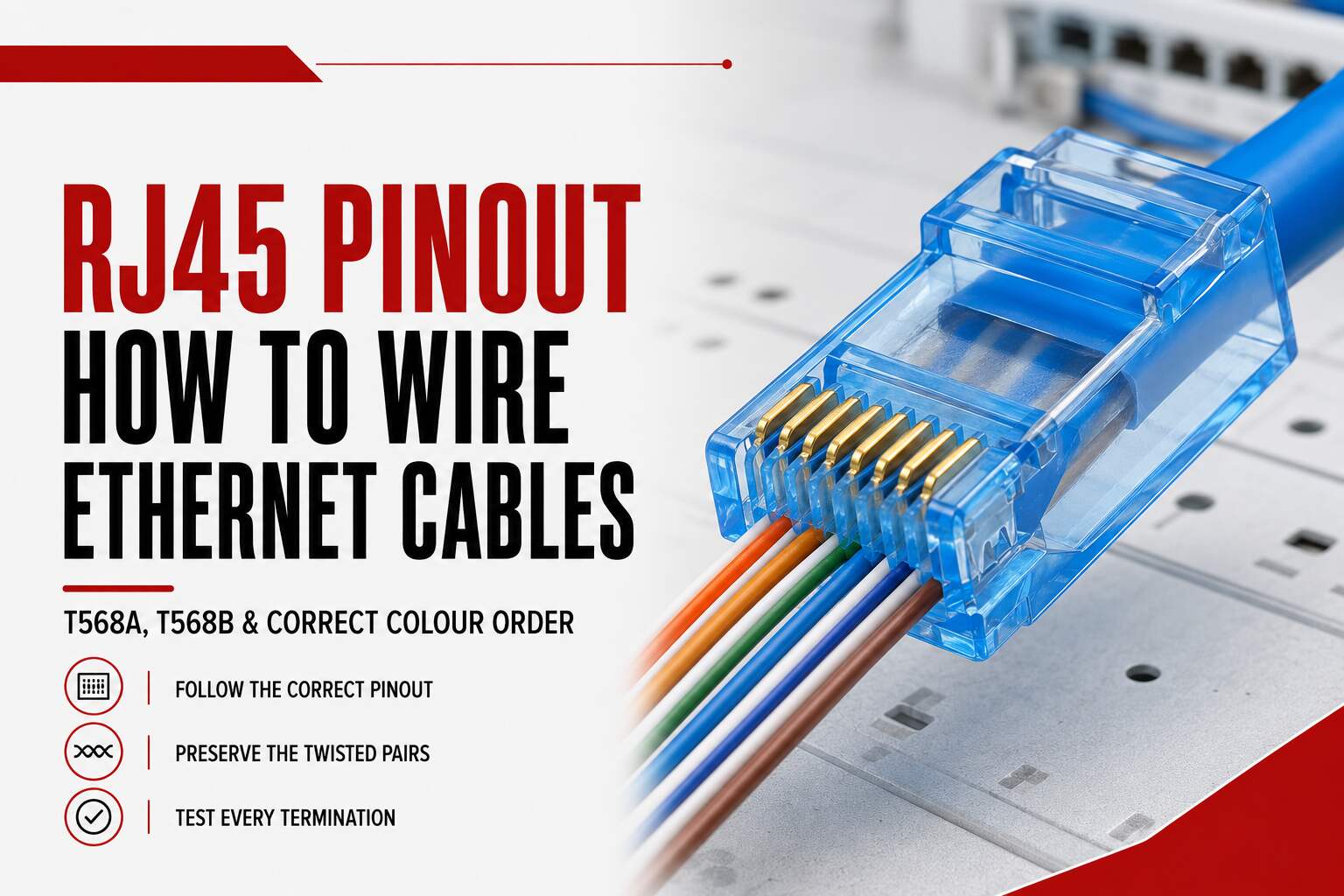
You’ll commonly use one of two wiring standards when connecting RJ45 wires: T568A or T568B. Both use the same eight wires, but in different colour orders. T568B is the most widely used in Australia, especially in commercial and residential networking.


There's more under "pinout":
T568A for residential installations
T568B for commercial networks and office patch cables

 
Last edited:
  • Like
Reactions: looney2ns
Excerpt from Andersen Corp, a fiber optic manufacturer in Australia:

You’ll commonly use one of two wiring standards when connecting RJ45 wires: T568A or T568B. Both use the same eight wires, but in different colour orders. T568B is the most widely used in Australia, especially in commercial and residential networking.


There's more under "pinout":
T568A for residential installations
T568B for commercial networks and office patch cables

Yea, you will use one of those two standards because they're the only two...

I found similar information. I believe most patch cables are T568B, so it would likely be best to use that standard over the older T568A, especially for new installs.
 
Is T568B not the standard ethernet wiring order used in Australia?
T568B is the standard Ethernet wiring pinout worldwide. The only reasons to use T568A is to make a crossover cable (where one side would be T568A and the other T568B) for connecting two devices directly to each other with no switch between them (e.g. connecting one PC's Ethernet port directly to another, or plugging a single camera directly into a PC's Ethernet port), or to match outdated preexisting wiring for consistency in an old building. Even so, most Ethernet devices these days support Auto MDI-X, allowing one device to automatically flip its RX/TX lines in this scenario, making T568A obsolete for all practical purposes. That said, your network really won't care what pinout you use as long as you keep the four pairs on twisted pairs in your cable and use the same pinout on both ends. It'll just look funny to any technician coming in after the fact, and potentially cause problems if a crimp/connector goes bad and they snip the plug off to crimp another one on, assuming standard T568B pinout when you used something else on the other end.
 
  • Like
Reactions: Valiant
T568B is the standard Ethernet wiring pinout worldwide. The only reasons to use T568A is to make a crossover cable...or to match outdated preexisting wiring for consistency in an old building.
Or for anything to do with the US government, which does cover a bit of the world.
Or to be compatible with USOC wiring.

"The T568A wiring pattern is recognized as the preferred wiring pattern for this standard, because it provides backward compatibility to both one-pair and two-pair USOC wiring schemes. The U.S. government requires the use of the preferred T568A standard for wiring done under federal contracts."

Differences Between Wiring Codes T568A vs T568B
 
  • Like
Reactions: Valiant