
Money & Economics

Air traffic controller here…

Where do we even start with this? I guess with the air traffic side since that’s what I know best.

One word: capacity!

DFW and Houston have big airports, that is true. But you can only fit so many airplanes and people in one place. Florida is a bigger problem. Most of their airports are suited for domestic flights, not international. Plus, the airspace is already extremely saturated. It is becoming one of the biggest bottlenecks in the entire US system, probably only behind the NY area.

Domestic airlines could theoretically make the switch. It would take a long time to redo their schedules and adjust departures and such. Flight crews would need different arrangements to get from wherever they end up. Also, this affects other flights since airlines use planes based on where they are. Plus the fuel use would be greater since most of these flights would require flying longer distances.

Foreign carriers could not easily switch. Asian ones almost exclusively have their US operations in California. European ones, in NY typically. Etc. They can’t just say, we’ll fly to DFW or wherever. Most don’t have gates there, maintenance crews, offloading crews, whatever else. It wouldn’t be an absolute nightmare.

Basically, it would take on the order of years to implement and cost airlines many millions of dollars. Which they would pass on to the customers in higher ticket prices.
Airlines would probably sue and at least try to stop this long before it’s put in place.

Not to mention, Mullins would be putting his own people out of work or forcing them to move.

 
  • Haha
Reactions: johnfitz
Data looks like this, red hot in the middle of the country

1780096801513.png

Typically we expected the coasts to be redhot .. what is going on ?

1780096898526.png


Americans Are About to Get a Lot Richer
Maxinomics


May 29, 2026 #USEconomy #Manufacturing #FreightData
There's a piece of data that almost nobody is paying attention to that is, right now, telling a story about the United States that most people on the coasts simply cannot feel.

It starts with a weird question: why is it nearly impossible to book a flatbed truck?

Not a refrigerated truck. Not a standard dry van. The flatbed specifically. No walls, no roof, cargo sitting in the open air getting rained on. The kind that only makes sense when your cargo physically cannot go inside a box — steel coils, heavy equipment, lumber. The workhorse of industrial America.

When the price to hire one doubles and companies pay it anyway, that's not a complaint. That's a choice. And choices like that don't lie.

We pulled the thread on this with Craig Fuller, founder of FreightWaves, who runs what is arguably the best real-time freight intelligence platform in the country. What he laid out completely reframed how we were looking at the US economy.

For thirty years, the freight heat map of this country looked the same: hot at the coasts where the ports are, quiet in the middle. Today that map is almost inverted. The I-35 corridor, the old Rust Belt, the industrial spine of the country is running at a pace it hasn't hit in two decades. And it has nothing to do with the ports.

This video traces what that signal actually means — and connects it to black swans, penicillin, a $150 billion data center arms race, and a productivity chart that should probably be getting more attention than it is.

By the end of it, you'll understand why I said something I've never said before.

Topics covered:
Why freight data is one of the few economic signals that genuinely cannot be faked
The I-35 corridor and the inversion of thirty years of US freight patterns
Why flatbed rejection rates specifically point to industrial activity, not consumer demand
Black swans: the ones that make headlines, and the more powerful ones that don't
AI productivity vs internet productivity, and what the gap between them might mean
Why Big Tech spending $150B+ a year racing each other might be the most accidental stimulus in American history


This video examines a compelling economic signal—the surging demand for flatbed trucks—to argue that the United States is undergoing a fundamental industrial revival. Here are the key takeaways:

The Freight Signal (0:00 - 8:23)

  • Flatbed Scarcity: Unlike standard dry van freight, flatbed trucks carry raw materials like steel and heavy equipment. The difficulty in booking them at current prices serves as a "revealed preference" that industrial activity in the U.S. is sharply increasing.
  • Geographic Shift: For decades, freight activity was concentrated at the coasts. Today, the map has inverted, with the I-35 corridor and the Rust Belt becoming the new hubs of activity.
  • Economic Meaning: This isn't just a temporary surge; it reflects that the "pipes" of American industry—moving raw materials to factories and goods to market—are finally full and operational again.
Tech and Productivity (8:24 - 14:41)

  • Big Tech Stimulus: Hyperscalers are engaged in a massive $150B+ arms race for AI data centers. This spending is effectively acting as an accidental, widespread stimulus for various industrial sectors.
  • The Productivity Gap: Data suggests that AI adoption is currently correlating with a faster rate of productivity growth than the initial emergence of the internet, which the narrator views as a major bullish signal for the economy.
Additional Factors (14:42 - 18:26)

  • Energy Advantage: The U.S. benefits from having some of the world's cheapest and most stable natural gas supplies, which is a critical advantage for heavy manufacturing—a factor that has contributed to Germany's recent industrial struggles.
  • Positive Black Swans: The narrator emphasizes that positive, transformative "black swan" events—like the discovery of penicillin or the birth of the internet—often occur without fanfare but produce profound, long-term wealth and productivity gains.
 
if you look back 50-60 pages you'll find a post of mine saying this exact thing. Once the IPO's are done, and they start selling, look out below.

 
  • Like
  • Wow
Reactions: johnfitz and mat200
Break down on the house of cards ..

Big Tech Is Faking Profits Too
Sasha Yanshin

May 31, 2026
Anthropic just closed a new funding round at a $965 valuation, landing Google $75 Billion in profit after already pocketing $28 Billion in Q1.

Tech companies are increasing valuations of companies they themselves are primary investors in, so that they can print ever increasing fake profits.

The infinite money glitch means that by circling the same money back and forth between your investments and back through revenue, you can decide how much profit you'd like every quarter.


This video, created by Sasha Yanshin, argues that major tech companies like Google and Amazon are artificially inflating their quarterly profits using a circular "infinite money glitch" involving their own investments in AI startups.

Key Arguments & Mechanisms:

  • The "Other" Income: The creator points out that a significant portion of Google's reported Q1 2026 profit is attributed to an "other" category (1:51-2:38), which is primarily driven by "gain on equity securities" (2:45) from re-evaluating investments in companies like Anthropic.
  • Circular Money Flows: The video asserts that Google and Amazon invest massive amounts into AI firms like Anthropic (4:03-4:40). These startups then use that same funding to pay for cloud services and data center compute power from the very companies that invested in them (9:56-10:42).
  • Inflated Valuations: By acting as primary investors, these tech giants can periodically drive up the valuation of their AI portfolio companies, allowing them to report massive, non-cash "paper profits" on their financial statements (6:34-7:12).
  • Impact on Financial Reporting: The creator claims that if you strip away these circular transactions and artificial valuation increases, the core growth of these businesses is significantly lower than the figures presented to the public (11:34-12:12).

Broader Implications:

  • Market Bubbles: Sasha Yanshin argues that this practice is being used to justify massive stock market valuations and record profits, benefiting executives who hold significant equity (15:16-16:47).
  • Potential Misconduct: The video draws comparisons to "round-tripping" (14:28-14:50), a practice often scrutinized by regulators, and suggests that the current era of AI investment is effectively engineering fake growth to keep stock prices rising (15:16-15:30).
 
Burry says its a house of cards and will fail spectacularly.

Scary part I just learned is that Apollo is behind much of it and sold the overvalued assets to its own subsidiary/partner company Athene.
Athene is a huge Insurance company who sells fixed income annuity's among other things, to many retirees.... including Me :rolleyes:

Now mine was a 5 year fixed annuity, with fixed percentage (5.25%) that matures in Fall of '28. Its not an insignificant part of our portfolio.
So while I'm not crazy worried, I am concerned that Athene is deep in it.

 
Last edited:
  • Wow
Reactions: mat200 and johnfitz
Not just the above AI ponzi scheme, but many fundamentals are all starting to crack. Housing, employment, wages, energy...

I think we'll see Oil and Food shoot up in price in the coming 4 weeks and like the post below I dont think we can trust any report out of our government at this point.

 
  • Wow
  • Sad
Reactions: mat200 and johnfitz
Not just the above AI ponzi scheme, but many fundamentals are all starting to crack. Housing, employment, wages, energy...

I think we'll see Oil and Food shoot up in price in the coming 4 weeks and like the post below I dont think we can trust any report out of our government at this point.


From the replies to that post... I realize you and another member have already mentioned these, but they just seem so relevant I'm repeating them again :) ...


Screenshot 2026-05-31 154042.png

Screenshot 2026-05-31 154101.png
 
Everyone should read what Senior Vice President of Exxon Neil Chapman says about the oil price surge coming in 2-3 weeks
The next wave of the energy shock is approaching fast


Last edited:
  • Wow
  • Sad
Reactions: mat200 and johnfitz
Congrats!

Stock Market reaches most expensive valuation in history, surpassing the Dot Com Bubble and the run-up to the Great Depression

 
  • Wow
Reactions: mat200 and johnfitz
"Treasury Secretary Scott Bessent openly admits the Trump administration is plotting to gut Medicare, Medicaid, and Social Security."

Does he blatantly say it? No. (calm down fact checker trolls)
Is Maria a paid shill for the Administration? Clearly.
Is her job to launch the idea and normalize it? Yes
Did he push back? No

This is where they are going.

Remember! they are trying to jam through a 50% increase in Defense spending from $1Trillion to $1.5Trillion in a single year. Unfuckingbelievable
It will come from SS and Medicare

Those of you clapping like dumb fucking seals just know, that you or someone in your immediate family will be effected.
This bullshit you've bought into about the problem being illegal aliens or bazillions of fraudulent claims doesn't put a tiny dent in those programs. You were sold a lie.

 
  • Exclamation
  • Angry
Reactions: mat200 and johnfitz
Valuation at IPO

Microsoft: $775m (1986)
Amazon: $475m (1997)
Nvidia: $75m (1999)
Tesla: $2B (2010)
Facebook: $100B (2012)
Uber: $80B (2019)
Palantir: $22B (2020)
SpaceX: $2000B, yes $2T estimated (2026)


  • Wow
Reactions: mat200 and johnfitz
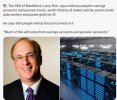
When the BlackRock CEO says the quiet part out loud, it stops being a “conspiracy theory.”

How did this quote not break the internet?


HJpjzjiaoAAYNdO.jpg

 
  • Wow
  • Sad
Reactions: mat200 and johnfitz
Stock Market reaches most expensive valuation in history, surpassing the Dot Com Bubble and the run-up to the Great Depression

More analysis suggesting bearish market ahead....


The stock market just did something eerily similar to the dot-com bubble top in 2000

The S&P 500 closed at a record on the last trading day of May, but only a handful of stocks — focused mostly in the AI area — hit their own all-time highs.

This strange occurrence echoes what happened at the top of dot-com bubble 26 years ago.

On Friday, just 20 of the index members hit a record. Of those 20, just seven were not directly related to artificial intelligence.

Michael Hartnett at Bank of America pointed out in a note to end last week that it was just 20 stocks that hit new highs at the very top of the internet bubble in March 2000.

A growing number of strategists and investors are concerned that if this bull market doesn’t start to broaden out, it will ultimately be its undoing.


Screenshot 2026-06-01 164413.png

 
  • Like
Reactions: bigredfish