
Money & Economics
- Thread starter bigredfish
- Start date

You are using an out of date browser. It may not display this or other websites correctly.
You should upgrade or use an alternative browser.
You should upgrade or use an alternative browser.
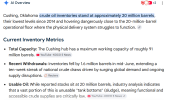


No guidance from the Fed, no more Quarterly reporting, no more pattern day trader status...
They're just throwing in the towel and admitting things are beyond salvaging.
Corruption will get worse, not better. We're heading towards hunger games
They're just throwing in the towel and admitting things are beyond salvaging.
Corruption will get worse, not better. We're heading towards hunger games

ATTENTION!
I AGREE WITH TRUMP ON THIS - I know, crazy talk coming from me...
I AGREE WITH TRUMP ON THIS - I know, crazy talk coming from me...


Admitted market manipulation (and obviously oil as our SPR strapped dry)
Those with just 6 brain cells won’t understand how bad of a precedent this is
It's not a laughing matter, but video just cracks me up...


mat200
IPCT Contributor
- Jan 17, 2017
- 19,561
- 32,642
$17B in Foreclosures Already — The Recoil Has Begun
Eckard Enterprises | Oil & Gas Investing
Jun 20, 2026
$17 billion in commercial real estate foreclosures already in 2026. The Fed just hinted at another rate hike. Troy Eckard's recoil forecast is no longer a warning — it's happening right now.
Commercial real estate foreclosures in 2026 have already surpassed the full-year total of each of the last 9 years — and it's only June. Yesterday, the Federal Reserve held rates at 3.5–3.75% under new chair Kevin Warsh, but signaled a raise to 3.8% by year-end. Rising oil and gasoline prices drove more than 60% of monthly inflation. The refinancing window is not opening.
The recoil has begun.Troy Eckard breaks down why this is the structural collapse most investors refused to see coming — and where the only safe positions are over the next 60–72 months.
In this video, industry veteran Troy Eckard discusses the ongoing crisis in the commercial real estate (CRE) market as of June 2026. He outlines the structural factors contributing to what he calls a "recoil," emphasizing that the sector is facing a severe downturn rather than a temporary slump.
Eckard Enterprises | Oil & Gas Investing
Jun 20, 2026
$17 billion in commercial real estate foreclosures already in 2026. The Fed just hinted at another rate hike. Troy Eckard's recoil forecast is no longer a warning — it's happening right now.
Commercial real estate foreclosures in 2026 have already surpassed the full-year total of each of the last 9 years — and it's only June. Yesterday, the Federal Reserve held rates at 3.5–3.75% under new chair Kevin Warsh, but signaled a raise to 3.8% by year-end. Rising oil and gasoline prices drove more than 60% of monthly inflation. The refinancing window is not opening.
The recoil has begun.Troy Eckard breaks down why this is the structural collapse most investors refused to see coming — and where the only safe positions are over the next 60–72 months.
In this video, industry veteran Troy Eckard discusses the ongoing crisis in the commercial real estate (CRE) market as of June 2026. He outlines the structural factors contributing to what he calls a "recoil," emphasizing that the sector is facing a severe downturn rather than a temporary slump.
Key Takeaways:
- CRE Crisis & Foreclosures: The market is facing a significant collapse, with $17 billion in foreclosures already recorded this year. Many owners, who were hoping for interest rate relief to facilitate refinancing, are instead seeing banks reclaim assets as loan covenants are broken (0:00-0:58).
- The Impact of Energy Prices: Rising costs for oil and gas—fueled by geopolitical instability—are acting as a "final nail in the coffin" for many businesses. Increased expenses for fuel, electricity, and construction are squeezing budgets across the board (0:04-0:28; 1:31-1:56).
- Interest Rate Outlook: Eckard notes that the Federal Reserve, under chair Kevin Warsh, is not expected to lower rates in the near term. This lack of relief leaves real estate investors with few options to salvage equity (0:58-1:30).
- AI and Labor Market Shifts: A major economic transformation is underway due to Artificial Intelligence. High-paying white-collar jobs are being rapidly replaced or reduced by AI automation, while blue-collar trade roles remain in high demand (3:22-5:24).
- Economic Forecast: The combination of stagflation risks, the widening gap between the wealthy and the middle class, and the structural changes in employment suggests that the next 60-72 months will be a period of significant economic volatility (3:46-4:01; 6:01-7:25).
Investment Outlook:
Troy Eckard suggests that investors should pivot away from distressed or speculative markets and focus on essential assets, including data centers (AI-driven tech), fundamental natural resources (mining, lithium, nickel, copper, and oil/gas), and specific, irreplaceable real estate (6:20-7:04).tigerwillow1
Known around here
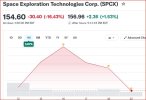
Gravity has not been repealed. What goes up......
I'm sure the insiders are rooting against the laws of physics!...
SpaceX has several big dates coming up that investors shouldn't forget
Don't let the daily frenzy around SpaceX's (SPCX) stock distract you from one looming reality: There are several lockup-period expiration dates coming, which could inject even more volatility into shares of the newly minted public company, as insiders will no longer be restricted from selling their stock.
All told, insiders could potentially sell as many as 44% of SpaceX shares by early September, Jacobson said, increasing the current float by about 900%.
mat200
IPCT Contributor
- Jan 17, 2017
- 19,561
- 32,642
AI and the question of valuation ..
This video, presented by Brendan Dell, analyzes the current AI landscape, arguing that the massive market hype surrounding OpenAI and Anthropic—both preparing for 2026 IPOs—rests on a potentially flawed narrative about "limitless" scale.
Key takeaways from the video include:
MIT Just Revealed the AI Bubble's Fatal Flaw
This video, presented by Brendan Dell, analyzes the current AI landscape, arguing that the massive market hype surrounding OpenAI and Anthropic—both preparing for 2026 IPOs—rests on a potentially flawed narrative about "limitless" scale.
Key takeaways from the video include:
- The "Limitless" Fallacy: The industry narrative suggests that increasing compute and data will inevitably lead to super-intelligence. Dell compares this to historical speculative bubbles like Enron, where companies were valued on unproven "prophecies" rather than fundamental profitability (1:52-4:46).
- The Scaling Debate: While Anthropic CEO Dario Amodei bets on scale as an "infinite money glitch," industry figures like Ilya Sutskever argue we have entered an "age of research" where raw scaling is yielding diminishing returns (10:31-12:47).
- The MIT Study Findings: Research suggests that "open" AI models are already achieving 90% of the performance of closed frontier models at a fraction of the cost, challenging the idea that a few companies hold an unassailable "moat" (13:46-15:20).
- The Financial Risk: The video posits that these companies are burning capital on hardware that depreciates rapidly. If the promised leap in capabilities doesn't materialize, the premium valuations could evaporate, potentially causing a market correction (16:30-18:02).


mat200
IPCT Contributor
- Jan 17, 2017
- 19,561
- 32,642
AMT is gonna be a killer for those working in the AI field ..
The Alternative Minimum Tax (AMT) is a parallel U.S. federal tax system that requires certain taxpayers to calculate their liability twice—once under regular income tax rules and once under AMT rules—and pay whichever amount is higher.
recall back in the day .. before people really knew what Linux was ..
VA Linux (LNUX): The most famous Linux-related ticker symbol was LNUX, used by VA Linux. The company had a record-breaking IPO in 1999, gaining ~700% on its first day
spoke to a few employees of that company who PAID more taxes than they made to Uncle Sam due to the AMT
( they were working like dogs and did not get to sell their employee stock in time and got nailed with major AMT )
tigerwillow1
Known around here
This happened with Incentive Stock Options in conjunction with the Y2K tech stock bubble. There's an incentive to hold ISO stock for a year after option exercise to qualify for long term capital gains rates, but there's also a trap. If the stock isn't sold during the same year as the option exercise, the price spread at exercise time is subject to AMT. So if the stock tanks, the amount of AMT can be more than the value of the stock, a potentially big net loss that could bankrupt somebody. There's a way to carry forward and eventually recover the loss, but if you don't have big future income you'll never be able to recover it.AMT is gonna be a killer for those working in the AI field ..
.
.
spoke to a few employees of that company who PAID more taxes than they made to Uncle Sam due to the AMT
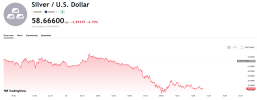
Ugghh... my silver still tanking today... 
And bitcoin holders probably ain't thrilled either...
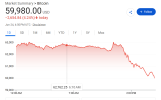
And bitcoin holders probably ain't thrilled either...
Its becoming painfully obvious that the .Gov is intervening in not just Oil futures markets, but the actual Stock markets.
At what point does it just become such a big lie that even MAGA sees it?
At what point does it just become such a big lie that even MAGA sees it?
Last edited:
BREAKING: Today a ban on the Federal Reserve issuing a digital dollar becomes law in the United States, on the stated fear that a government version could let the state freeze or monitor your money. The private stablecoins the same law protects already freeze balances on government order. Tether alone has frozen more than 4 billion dollars.
The ban rode a 374-page housing bill that cleared the Senate 85 to 5 and the House 358 to 32. It blocks a Fed retail digital dollar through 2030, and after that only with a new act of Congress. The Fed was not even building one. Washington banned a phantom.
The thing CBDC opponents feared most, a switch the government can flip to cut off your money, was not outlawed. It was privatized. Under last year's stablecoin law, issuers must be federally licensed and able to freeze or seize balances on a lawful order. The biggest already do, routinely. The state did not give up the off-switch. It now reaches it through Tether and Circle instead of the Fed, and skips the political fight a government coin would have triggered.
The ban rode a 374-page housing bill that cleared the Senate 85 to 5 and the House 358 to 32. It blocks a Fed retail digital dollar through 2030, and after that only with a new act of Congress. The Fed was not even building one. Washington banned a phantom.
The thing CBDC opponents feared most, a switch the government can flip to cut off your money, was not outlawed. It was privatized. Under last year's stablecoin law, issuers must be federally licensed and able to freeze or seize balances on a lawful order. The biggest already do, routinely. The state did not give up the off-switch. It now reaches it through Tether and Circle instead of the Fed, and skips the political fight a government coin would have triggered.