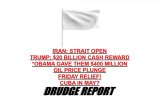
Is the regime in Iran soon to be toast?

There is NO fundamental change in the Straight today vs the past few days.

This is pure panic TACO on Trump's part as he's discovering his reputation, respect (what little he had) and legacy is going down the toilet, and Republican's chances for midterms has tanked


Traffic still limited, no agreement, and this

 
  • Haha
  • Like
Reactions: Parley and wrapter


  • Like
  • Haha
Reactions: mat200 and Parley


NINETY-FOUR MINUTES

On Friday April 17, between 9:06 and 10:40 AM Eastern, the President posted six Truth Social messages that crashed oil ten percent, contradicted his officials on a twenty billion dollar deal, called NATO a Paper Tiger, and unilaterally declared Iran had permanently surrendered a strait Iran had opened for ten days. While he posted, Macron and Starmer convened forty-nine countries in Paris on the same strait and did not invite the US.

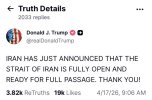
9:06 AM. IRAN HAS JUST ANNOUNCED THAT THE STRAIT OF IRAN IS FULLY OPEN AND READY FOR FULL PASSAGE. THANK YOU. Araghchi had posted the strait was open for commercial vessels only, on the IRGC coordinated route, for the remaining ten-day ceasefire. Ten days, amplified as full passage.

9:27 AM. THE STRAIT OF HORMUZ IS COMPLETELY OPEN AND READY FOR BUSINESS AND FULL PASSAGE, BUT THE NAVAL BLOCKADE WILL REMAIN IN FULL FORCE UNTIL OUR TRANSACTION WITH IRAN IS 100% COMPLETE. A transaction. Collateralized by a blockade. Word chosen with care.

9:57 AM. The U.S.A. will get all Nuclear Dust created by our great B-2 Bombers. No money will exchange hands in any way, shape, or form. Hours earlier Axios had published that two US officials plus two sources confirmed a three-page MOU releasing twenty billion in frozen Iranian funds for Iran’s enriched uranium. The President denied it. Either his officials briefed Axios on a ghost or he torched the MOU live.

10:13 AM. Now that the Hormuz Strait situation is over, I received a call from NATO asking if we would need some help. I TOLD THEM TO STAY AWAY. They were useless when needed, a Paper Tiger. NATO severed on Truth Social while Macron and Starmer walked into the Élysée.

10:20 AM. Iran, with the help of the U.S.A., has removed, or is removing, all sea mines. The NYT reported April 11 that Iran had lost track of its own mines. Credit claimed for a capability Tehran denied having.

10:40 AM. The closing argument. IRAN HAS AGREED TO NEVER CLOSE THE STRAIT OF HORMUZ AGAIN. IT WILL NO LONGER BE USED AS A WEAPON AGAINST THE WORLD. No signed agreement. No Iranian countersignature. No IRGC acknowledgment. No verification regime. No UN instrument. A unilateral American declaration that an adversary surrendered its most valuable asset. 13,100 Likes in the first hour, more than the previous five combined.

Then Paris.

Macron and Starmer convened forty-nine countries at the Élysée and branded it the Strait of Hormuz Maritime Freedom of Navigation Initiative. The US was not invited. Macron declared it strictly defensive, opposed any toll system. Starmer said Iran is holding the world economy to ransom. France’s nuclear carrier is in the region.

The architecture is now naked. WTI down ten percent to $85.19. Brent down ten percent to $90.52. Blockade stays until the transaction is 100% complete. Pakistan flew two dozen fighters to shield Iranian negotiators from Israel’s kill list. Khomeyn and Isfahan still being dug out.

Falsifiable prediction. Before May 1, Araghchi or IRGC Arabic publicly contradicts the permanent-closure claim in writing, or the European Hormuz Initiative deploys a non-US asset without CENTCOM coordination. Kill condition. If Iran signs an instrument endorsing the never-close framing before April 30, the unilateral-declaration thesis is dead.

A presidency that contradicts itself six times in ninety-four minutes is not improvising. It is rehearsing every ending while Europe writes its own.

 
  • Like
Reactions: wrapter


SECURITY COMPANY TELLS CLIENTS NOT TO CROSS STRAIT YET AFTER IRAN SAID IT'S OPEN

A maritime security firm is urging caution and advising ships not to enter the Strait of Hormuz yet, despite Iran stating it is open.

Neptune P2P Group reports clients have been told to wait for official guidance, with vessels still directed onto specific routes. The company warns of potential risks outside these corridors, including the possibility of naval mines.


From a failed coup, to a failed regime change operation and a failed attempt to kill diplomacy and send Iran, an isolated and sanctioned nation, back to the Stone Age, we have arrived at a point where Iran has now dictated the terms for a ceasefire to the US, has managed to put a leash on Israel as the first and only country in the world to protect its allies, has forced the US to unfreeze Iran’s assets and perhaps soon lift all sanctions and Trump to praise Iran to save his own face. Meanwhile, Iran has maintained its sovereignty and completely restored its image on the world stage like a phoenix rising from the ashes.

As it stands today, this will go down in history as one of the greatest strategic achievements ever. :rofl:
 
  • Haha
Reactions: wrapter and Parley
It is hard to even grasp the full extent of the defeat of the U.S.

Iran rendered practically all U.S. bases in the region uninhabitable, and the only way the "greatest military in the world" was able to retaliate was to sink an unarmed frigate and resort to piracy.

Just consider the depth the U.S. had sunk into.

 
  • Haha
  • Like
Reactions: wrapter and Parley


IRGC-affiliated Fars News cites an informed source saying Iran set three conditions for the reopening of the Strait of Hormuz under the ceasefire.

1. Ships must be commercial, and neither the ships nor cargo can be related to “hostile countries.”

2. Ships must pass through Iran’s designated route.

3. The passage of ships must be coordinated with the IRGC.

The informed source stated that the reopening of the Strait of Hormuz is dependent on the implementation of some terms and conditions of the ceasefire in Lebanon.

The source added that if the
U.S. naval blockade continues, it will be considered a violation of the ceasefire and passage through the Strait of Hormuz will be closed.
 
Welp that worked well huh?


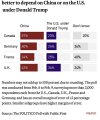
This is a remarkable shift.

People in every single one of the top US-allied countries now believe it’s better to depend on China than on the US.

The global balance of power is clearly tilting away from the US and toward China.

1776446374976.jpeg
 
Blockade .. here is better info from Sal on this ..


1776447764711.png


US Executes Blockade Against Iran | Turns Ships Around and Threatens to Board Iranian Ships Globally
What's Going on With Shipping?

Apr 17, 2026 What's Going on With Shipping - Maritime Industry Today
The Pentagon briefed on the initiation of blockade operations while the Joint Maritime Information Center released details on the search for contraband on board ships.


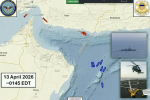
This video, presented by Sal Mercogliano, details the United States' formal blockade of Iranian ports and coastal areas, which officially commenced on April 13, 2026 (1:53, 2:50).

Key takeaways include:

  • Blockade Parameters: The blockade line is established between the Iran-Pakistan border and the northeast corner of Oman (2:07-2:16). The enforcement requires all vessels to avoid entering or departing Iranian ports, with the US Navy authorized to intercept, board, and seize ships failing to comply (0:14-0:21, 8:47-8:56).
  • Enforcement Strategy: While initially thought to target only outbound ships, the blockade is being enforced for both inbound and outbound traffic (6:31-6:43). Multiple ships have been challenged and forced to divert or return to port (5:56-6:07, 6:43-6:49).
  • Expanded Authorities: A new advisory from the Joint Maritime Information Center expands these powers beyond the immediate blockade zone (14:34-14:41). The US now claims the right to visit, search, and seize Iranian-linked vessels and those suspected of carrying "contraband"—including oil, metals, and electronics—anywhere on the open seas (9:22-10:40, 14:48-15:02).
  • Regional Impact: The Persian Gulf is effectively being bottled up, with commercial traffic severely limited (7:16-7:25). Despite the blockade, some tankers continue to transit into the area, setting the stage for potential "Venezuela-style" tanker chases (12:03-12:15, 13:00-13:28).
  • Global Market Effects: The conflict has significantly pushed the United States toward becoming a net oil exporter, with US crude exports rising as imports decrease (15:29-16:32).
 
iirc someone posted this earlier here or in another thread ..

It is a very good video, worth watching to better understand the situation.


Trump Just Flipped The Entire Game On Iran - Something Much Bigger Is Unfolding
JNS TV and Doron Spielman

Apr 15, 2026 True East
This episode isn’t just another geopolitical update, it’s a masterclass in how power, patience and strategy collide on the global stage.
Doron Spielman (IDF Spokesman (Res.)) explains how Iran weaponizes time and chaos, why oil is far more than just energy (it’s leverage) and how the U.S. may have flipped the entire game by turning Iran’s biggest strength into its greatest vulnerability. Beneath the headlines lies a psychological and economic battle where the real question isn’t about deals, but about endurance and who breaks first. By the end, you’ll understand the hidden rules shaping this conflict and why the outcome could define the next decade of global power.


This video, presented by Doron Spielman, analyzes the high-stakes geopolitical standoff between the United States and Iran, framing it as a test of endurance rather than a traditional negotiation.

Key Takeaways:

  • Iran's Strategy: The Iranian regime relies on "patience as a weapon," aiming to muddy the waters, exhaust its opponents, and outlast them (0:51-1:49). Their main leverage points include energy disruption in the Straits of Hormuz and manipulating the timing of U.S. political cycles (2:11-4:24).
  • The U.S. Counter-Strategy: The U.S. has effectively turned the table on Iran by keeping shipping lanes in the Straits of Hormuz open to international trade while specifically blocking Iranian oil exports (5:29-6:09). This creates a wedge between Iran and its partners, like China, forcing them to either pressure Iran to back down or rely on the U.S. to keep routes open (6:22-7:04).
  • Economic Suffocation: Beyond sanctions, the U.S. is leveraging the reality of oil infrastructure. By preventing oil exports, storage facilities reach capacity, causing production to halt and degrading oil wells, which often cannot be restarted to their previous capacity (7:23-8:32).
  • The Goal: The U.S. and Israel are pursuing a "grand bargain" centered on the complete dismantling of Iran's nuclear program and zero enrichment, rather than a partial deal (10:04-11:32).
  • The Strategic Outlook: The conflict is a battle of will. Spielman argues that the U.S. remains committed to building military and economic pressure simultaneously, ensuring that Iran cannot survive long-term without compromising its nuclear ambitions (9:09-10:03, 13:14-14:06).
 
"A once in a lifetime chance ... "

"the left will do whatever it can to stop a Trump win .. "


Victor Davis Hanson's take ..


No Deals, No Mercy: Trump’s Strategy Has Iran on the Brink | Victor Davis Hanson
The Daily Signal
Apr 17, 2026 #DailySignal

The Iranian regime had decades to build a workaround for the Strait of Hormuz, like building a large port facility on the other side of the strait. But they didn’t. Why?

They were so arrogant and thought that they were always going to intimidate everybody and no one was ever going to intimidate them.

So basically now where we are is Iran is quickly going broke. It’s going to implode. The population is restive, and we’re in the driver’s seat.

So if you game it out, you say, well, how many days can they survive? Probably a week, 10 days.


This video features Victor Davis Hanson discussing the current geopolitical situation regarding Iran, the Strait of Hormuz, and the impact of U.S. policy.

Key takeaways include:

  • Iran's Strategic Failure: Hanson argues that the Iranian regime failed to build infrastructure, such as ports and pipelines, outside the Strait of Hormuz due to arrogance, leaving them vulnerable to U.S. control of the strait (0:34-1:07).
  • Economic Pressure: With the U.S. controlling the strait and preventing oil transit, Iran is reportedly going broke and nearing collapse. Hanson estimates the regime could survive only a week or ten days under these pressures (1:14-1:33).
  • Internal Instability: The Iranian population is described as increasingly "restive" and dissatisfied with the government's spending on regional proxies and military programs while the economy fails (2:24-2:45). The regime's reputation for being a feared regional power is fading, leading to internal mockery and anger (3:34-4:31).
  • Foreign Policy Strategy: Hanson suggests that the U.S. should avoid premature negotiations, drag out the process, and maintain pressure to ensure the regime's total collapse, comparing the potential outcome to the fall of the Berlin Wall (4:31-5:00, 5:37-6:00).
  • Critique of the Media: The discussion concludes with a critique of the media—specifically mentioning the Wall Street Journal—for maintaining a pessimistic "gloom and doom" narrative regarding these developments (6:26-7:28).
 
View attachment 242128

Depend on China FOR WHAT?

You would have to ask them

I believe it was more of a general question.

Europe, much of the ME, and many countries no longer see the US as a reliable partner on many levels.

This is in the news daily.

That isn’t to say they’ll never talk to us again, won’t do any business etc. It means the US has lost the moral high ground it once occupied

To think that because some talking heads on YouTube think the grand plan 6D chess is working in our favor thus far is to ignore the reality around the world

Not a single stated strategic goal has been achieved.

Yes we’ve set Iran back decades financially. We’ve destroyed a lot of shit. We’re good at that.

For what?
 
Last edited:
  • Like
Reactions: wrapter and mat200