
Do you use a patch panel?

One thing to keep in mind is that if you’re going to be poking around where your cables are, having some sort of strain relief is important so you don’t accidentally make a good connection intermittent. Or just pull it off. :). So if this is a switch where some cables are permanently mounted and others are being plugged any unplugged as needed you’ll probably want either a patch panel or strain relief bar to tie them to to.

Also the callout about not crimping connectors onto solid core cable is really important. There are “field termination plugs” intended for that use case but there expensive, only good for this purpose and it’s much easier to just do a proper punch down then.
 
  • Like
Reactions: SpacemanSpiff
Al ethernet runs are solid cat6 and using RJ45's on those are not recommended which is also my own experience.

Also the callout about not crimping connectors onto solid core cable is really important.
I'd like to know more about this recommendation. I've got close to a hundred RJ45s on solid wire, using connectors spec'd for solid wire, with no problems whatsoever except for those that were my own error.
 
  • Like
Reactions: 97JeepXJ
This is the part many people skip.

A lot of my thinking on this was driven by Selecting the Correct RJ45 Connector | trueCABLE which I do note is talking about high bandwidth connections. I really like their writing style, although it is focused on a much more performant usage of ethernet than what IP Cameras usually encounter.
Interesting. They seem to think keystone jacks / patch panels help signal integrity versus crimping an RJ45 male connector directly onto solid copper ethernet cable. But they don't provide any actual evidence. So for all I can tell they are just trying to sell you more equipment.
 
Interesting. They seem to think keystone jacks / patch panels help signal integrity versus crimping an RJ45 male connector directly onto solid copper ethernet cable. But they don't provide any actual evidence. So for all I can tell they are just trying to sell you more equipment.
You've inadvertently prodded me into spouting off. trueCable does have a lot of info, but I don't automatically take it seriously ever since I read one of their writeups that explains skin depth, which they totally massacred.
 
  • Like
Reactions: bp2008 and TonyR
I used to install racks and punch down patch panels in Network closets at Hospitals for GE Healthcare. Had to. I had to keep up with the Jone's, ( IT managers/Bio-Med guys) I kinda liked that organized feeling, and ease of sending an ethernet run anywhere you needed it to by moving keystones around or using Patch cords.
I am currently Patch Panel-less. Using Home runs.
Recently, I noticed that my some of my Dahua cams dislike the pass thru CAT 5e RJ45 connectors that I bought at Home Depot ( Klein I think) Can't get that sure feeling "click".
and over time I'm seeing corrosion, at the very end of the copper...unlike my older Klein Non-Pass_Thru's.
But they work fine in the PoE switches and routers.
I think I'll be going back to " Old School" Non-Pass thru's on my next purchase for the outdoor Camera end of the run.
I had a few Klein "non pass-thru's left and they clicked into the female Camera end more firmly. AND the copper isnt exposed at the end of the wire.

I don't do much terminating anymore so I can live with the "old school" method.
 
Last edited:
  • Like
Reactions: bp2008 and TonyR
Interesting. They seem to think keystone jacks / patch panels help signal integrity versus crimping an RJ45 male connector directly onto solid copper ethernet cable. But they don't provide any actual evidence. So for all I can tell they are just trying to sell you more equipment.
It'll take more than verbose articles from a network cable and/or connector manufacturer to convince me that introducing more mechanical connections by using keystone connectors and patch cables in a patch panel is ALWAYS more desirable than less mechanical connections realized from direct cable connections and no patch panel.

Patch panels have their place but it's not a "one size fits all" type of scenario....IMO and experience. :cool:
 
I think I'll be going back to " Old School" Non-Pass thru's on my next purchase for the outdoor Camera end of the run.
The "insert" type of RJ45s sold by monoprice are no more difficult to use than pass-throughs and have closed ends. IMO of course, and I hope I don't sound like a commisioned salesperson for as many times as I've said this.
 
  • Love
Reactions: Flintstone61
I'd like to know more about this recommendation. I've got close to a hundred RJ45s on solid wire, using connectors spec'd for solid wire, with no problems whatsoever except for those that were my own error.

I'm not the person to fight on this or have strong opinions. But on local forums all this is a recurring discussion with pro's and cons.
Anyway; the way we install networkcabling in The Netherlands (especially in new build homes) is run solid wire in the wall, terminating in wall sockets on one end and in a central location usually the meter cupboard on the other end.
Wall sockets are usually punch down or keystones to fit in with all other wall sockets (power). At the central location is to each his own.
Most would probably just use some RJ45 and put them in a switch since most home don't have many runs. Most people use some mesh wifi kits anyway.

Personally I don't have good experiences with RJ45's on solid wire and I find a patch panel (small or large) just a way nicer, cleaner look.
Especially if you have each run labelled on the patch panel.
 
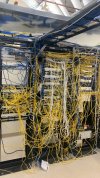
A lot of IDF cabinets and server rooms I have worked on in the past resemble this picture when you opened the door. The initial runs installed to the punch downs were fairly neat and organized. Where the wild jungle came from was the lazy assed IT guys who didn't want to look for the right length patch cable and grabbed 30' cables to run to a switch port 14" away, because they were the only thing they could find on the shelf at that moment. They always promised to come back and install the correct patch cable later on.........as they shut the light off and slammed to door shut, never to mess with that circuit ever again.oblxjfa6lzsc1.jpeg