
Climate Change

Sep 5, 2016
34,191
81,727
The Swamp
Yes the climate changes.
It has ZERO to do with CO2 @400 ppm
That big fucking yellow thing in the sky might just have some affect

——/

Chris Martz

I'll explain this to ya like you're five. So, turn your ears on and put your five-finger sausage tuggers down.


It's my turn to talk. It's your turn to listen.

Let's continue. . .

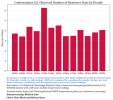
The chart I plotted on the left shows the annual mean number of heatwave days (HWDs) per decade since the 1890s at all NOAA USHCNd stations with at least 100-years of daily temperature data. ️

. - .

Notice I put the text above in for you. I did that so you wouldn't miss it. I'm always looking out for you buddy o' pal. Don't sweat it.

Keep that in the back of your mind.

Oh, and silly me, I almost forgot. . .

Here, I defined a HWD the number of days per year at a given station with a daily maximum temperature that is equal to or exceeds the 90th percentile for that day relative to 1961-1990 climatology for, at a minimum, three consecutive days [as per World Meteorological Organization standards].

Was any of that confusing?

Are we on the same page?

I hope so. I'm on page 69. Isn't that nice?

Let's move on. . .

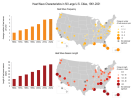
Now, the chart you linked to shows the annual average number of heatwaves per decade since the 1960s and it consists of data taken from 50 large U.S. cities, most of which are shown to be located in the eastern third of the CONUS and along the west coast.

Now, if you're smarter than a toothpick, there are two glaring problems with the data you presented. Let's see if you can figure it out all on your own first. This is a good mental exercise.

I smell smoke.

Were you thinking too hard again? ⚙️

Someone call the woo woo bus.

sirens

Let's put out that brain fart. Pshhhh. ‍

Alright. Well, you tried.

See, the two problems with your attempt of a rebuttal are:

➊ The data I presented begins in 1891. The data that you presented from the U.S. Global Change Research Program arbitrarily selects 1961 as the starting date. That's what you call cherry-picking.

➋ The data I presented was compiled from over 800 USHCNd stations with at least a century of data. The chart you presented was created using temperature data from 50 large U.S. cities that are compromised by urban heat island (UHI) effects which increasingly give artificially high readings.

No serious scientist would use the data you presented to make a point about climate [change].

But, since this was featured in the latest U.S. National Climate Assessment (NCA5), it is clear that some of the scientists or bureaucrats involved in writing this report were a few French fries short of a Happy Meal.

Hope that clarifies any confusion you might have.
IMG_7903.png IMG_7904.png
 
Yes the climate changes.
It has ZERO to do with CO2 @400 ppm
That big fucking yellow thing in the sky might just have some affect

——/

Chris Martz

I'll explain this to ya like you're five. So, turn your ears on and put your five-finger sausage tuggers down.


It's my turn to talk. It's your turn to listen.

Let's continue. . .

The chart I plotted on the left shows the annual mean number of heatwave days (HWDs) per decade since the 1890s at all NOAA USHCNd stations with at least 100-years of daily temperature data. ️

. - .

Notice I put the text above in for you. I did that so you wouldn't miss it. I'm always looking out for you buddy o' pal. Don't sweat it.

Keep that in the back of your mind.

Oh, and silly me, I almost forgot. . .

Here, I defined a HWD the number of days per year at a given station with a daily maximum temperature that is equal to or exceeds the 90th percentile for that day relative to 1961-1990 climatology for, at a minimum, three consecutive days [as per World Meteorological Organization standards].

Was any of that confusing?

Are we on the same page?

I hope so. I'm on page 69. Isn't that nice?

Let's move on. . .

Now, the chart you linked to shows the annual average number of heatwaves per decade since the 1960s and it consists of data taken from 50 large U.S. cities, most of which are shown to be located in the eastern third of the CONUS and along the west coast.

Now, if you're smarter than a toothpick, there are two glaring problems with the data you presented. Let's see if you can figure it out all on your own first. This is a good mental exercise.

I smell smoke.

Were you thinking too hard again? ⚙️

Someone call the woo woo bus.

sirens

Let's put out that brain fart. Pshhhh. ‍

Alright. Well, you tried.

See, the two problems with your attempt of a rebuttal are:

➊ The data I presented begins in 1891. The data that you presented from the U.S. Global Change Research Program arbitrarily selects 1961 as the starting date. That's what you call cherry-picking.

➋ The data I presented was compiled from over 800 USHCNd stations with at least a century of data. The chart you presented was created using temperature data from 50 large U.S. cities that are compromised by urban heat island (UHI) effects which increasingly give artificially high readings.

No serious scientist would use the data you presented to make a point about climate [change].

But, since this was featured in the latest U.S. National Climate Assessment (NCA5), it is clear that some of the scientists or bureaucrats involved in writing this report were a few French fries short of a Happy Meal.

Hope that clarifies any confusion you might have.
View attachment 206942 View attachment 206941
The ONLY thing I see differently from Martz is that he said "it is clear that some of the scientists or bureaucrats involved in writing this report were a few French fries short of a Happy Meal."

He could be right but I think they knew EXACTLY how to report their intentionally selected ("cherry-picked") data in order to achieve the desired results....to show that we are experiencing an extreme and trending uptick in climate change due mainly to warming. The end game, of course, is to promote EV's and end the use of fossil-based fuels.

I recall in the 1967 film "The Graduate" when Mr. McGuire (Walter Brooke) tells Ben Braddock (Dustin Hoffman) "I just want to say one word to you.....plastics. There's a great future in plastics."

Well, there's an even better future in the replacement for plastics, a substitute that functions the same but won't use any petroleum......now THAT will be quite an accomplishment, IMO.
 
Not only do they cherry pick data and how to present it, but they also do "adjustments" to those data prior to showing it. I looked into a study many years ago and even went to the bother of checking their data against the raw data that were recorded. They made "corrections" to the temperature data that they stated were to "baseline" all of the readings. The problem was, they are temperature readings. What needs to be adjusted? They never stated, but every single adjustment increased the value, never once was an adjustment that decreased the value. That proved to me that it is all a grift. These 'scientists' are in it for the grant money and private sector payments.
 
Concensus???

These are the words of 46 scientists that have left the IPPC due to the corruption of science within the organization. Enjoy!
  • Dr Robert Balling: The IPCC notes that “No significant acceleration in the rate of sea level rise during the 20th century has been detected.” This did not appear in the IPCC Summary for Policymakers.
  • Dr Lucka Bogataj: “Rising levels of airborne carbon dioxide don’t cause global temperatures to rise…. temperature changed first and some 700 years later a change in aerial content of carbon dioxide followed.”
  • Dr John Christy: “Little known to the public is the fact that most of the scientists involved with the IPCC do not agree that global warming is occurring. Its findings have been consistently misrepresented and/or politicized with each succeeding report.”
  • Dr Rosa Compagnucci: “Humans have only contributed a few tenths of a degree to warming on Earth. Solar activity is a key driver of climate.”
  • Dr Richard Courtney: “The empirical evidence strongly indicates that the anthropogenic global warming hypothesis is wrong.”
  • Dr Judith Curry: “I’m not going to just spout off and endorse the IPCC because I don’t have confidence in the process.”
  • Dr Robert Davis: “Global temperatures have not been changing as state of the art climate models predicted they would. Not a single mention of satellite temperature observations appears in the IPCC Summary for Policymakers.”
  • Dr Willem de Lange: “In 1996 the IPCC listed me as one of approximately 3000 “scientists” who agreed that there was a discernible human influence on climate. I didn’t. There is no evidence to support the hypothesis that runaway catastrophic climate change is due to human activities.”
  • Dr Chris de Freitas: “Government decision-makers should have heard by now that the basis for the long-standing claim that carbon dioxide is a major driver of global climate is being questioned; along with it the hitherto assumed need for costly measures to restrict carbon dioxide emissions. If they have not heard, it is because of the din of global warming hysteria that relies on the logical fallacy of ‘argument from ignorance’ and predictions of computer models.”
  • Dr Oliver Frauenfeld: “Much more progress is necessary regarding our current understanding of climate and our abilities to model it.”
  • Dr Peter Dietze: “Using a flawed eddy diffusion model, the IPCC has grossly underestimated the future oceanic carbon dioxide uptake.”
  • Dr John Everett: “It is time for a reality check. The oceans and coastal zones have been far warmer and colder than is projected in the present scenarios of climate change. I have reviewed the IPCC and more recent scientific literature and believe that there is not a problem with increased acidification, even up to the unlikely levels in the most-used IPCC scenarios.”
  • Dr Eigil Friis-Christensen: “The IPCC refused to consider the sun’s effect on the Earth’s climate as a topic worthy of investigation. The IPCC conceived its task only as investigating potential human causes of climate change.”
  • Dr Lee Gerhard: “I never fully accepted or denied the anthropogenic global warming concept until the furore started after NASA’s James Hansen’s wild claims in the late 1980s. I went to the [scientific] literature to study the basis of the claim, starting with first principles. My studies then led me to believe that the claims were false.”
  • Dr Indur Goklany: “Climate change is unlikely to be the world’s most important environmental problem of the 21st century. There is no signal in the mortality data to indicate increases in the overall frequencies or severities of extreme weather events, despite large increases in the population at risk.”
  • Dr Vincent Gray: “The [IPCC] climate change statement is an orchestrated litany of lies.”
  • Dr Mike Hulme: “Claims such as ‘2500 of the world’s leading scientists have reached a consensus that human activities are having a significant influence on the climate’ are disingenuous … The actual number of scientists who backed that claim was only a few dozen.
  • Dr Kiminori Itoh: “There are many factors which cause climate change. Considering only greenhouse gases is nonsense and harmful.”
  • Dr Yuri Izrael: “There is no proven link between human activity and global warming. I think the panic over global warming is totally unjustified. There is no serious threat to the climate.”
  • Dr Steven Japar: “Temperature measurements show that the climate model-predicted mid-troposphere hot zone is non-existent. This is more than sufficient to invalidate global climate models and projections made with them.”
  • Dr Georg Kaser: “This number [of receding glaciers reported by the IPCC] is not just a little bit wrong, it is far out by any order of magnitude … It is so wrong that it is not even worth discussing.”
  • Dr Aynsley Kellow: “I’m not holding my breath for criticism to be taken on board, which underscores a fault in the whole peer review process for the IPCC: there is no chance of a chapter [of the IPCC report] ever being rejected for publication, no matter how flawed it might be.”
  • Dr Madhav Khandekar: “I have carefully analysed adverse impacts of climate change as projected by the IPCC and have discounted these claims as exaggerated and lacking any supporting evidence.”
  • Dr Hans Labohm: “The alarmist passages in the IPCC Summary for Policymakers have been skewed through an elaborate and sophisticated process of spin-doctoring.”
  • Dr Andrew Lacis: “There is no scientific merit to be found in the Executive Summary. The presentation sounds like something put together by Greenpeace activists and their legal department.”
  • Dr Chris Landsea: “I cannot in good faith continue to contribute to a process that I view as both being motivated by pre-conceived agendas and being scientifically unsound.”
  • Dr Richard Lindzen: “The IPCC process is driven by politics rather than science. It uses summaries to misrepresent what scientists say and exploits public ignorance.”
  • Dr Harry Lins: “Surface temperature changes over the past century have been episodic and modest and there has been no net global warming for over a decade now. The case for alarm regarding climate change is grossly overstated.”
  • Dr Philip Lloyd: “I am doing a detailed assessment of the IPCC reports and the Summaries for Policy Makers, identifying the way in which the Summaries have distorted the science. I have found examples of a summary saying precisely the opposite of what the scientists said.
  • Dr Martin Manning: “Some government delegates influencing the IPCC Summary for Policymakers misrepresent or contradict the lead authors.”
  • Steven McIntyre: “The many references in the popular media to a ‘consensus of thousands of scientists’ are both a great exaggeration and also misleading.”
  • Dr Patrick Michaels: “The rates of warming, on multiple time scales, have now invalidated the suite of IPCC climate models. No, the science is not settled.”
  • Dr Nils-Axel Morner: “If you go around the globe, you find no sea level rise anywhere.”
  • Dr Johannes Oerlemans: “The IPCC has become too political. Many scientists have not been able to resist the siren call of fame, research funding and meetings in exotic places that awaits them if they are willing to compromise scientific principles and integrity in support of the man-made global-warming doctrine.”
  • Dr Roger Pielke: “All of my comments were ignored without even a rebuttal. At that point, I concluded that the IPCC Reports were actually intended to be advocacy documents designed to produce particular policy actions, but not a true and honest assessment of the understanding of the climate system.”
  • Dr Paul Reiter: “As far as the science being ‘settled,’ I think that is an obscenity. The fact is the science is being distorted by people who are not scientists.”
  • Dr Murry Salby: “I have an involuntary gag reflex whenever someone says the science is settled. Anyone who thinks the science is settled on this topic is in fantasia.”
  • Dr Tom Segalstad: “The IPCC global warming model is not supported by the scientific data.”
  • Dr Fred Singer: “Isn’t it remarkable that the Policymakers Summary of the IPCC report avoids mentioning the satellite data altogether, or even the existence of satellites — probably because the data show a slight cooling over the last 18 years, in direct contradiction of the calculations from climate models?”
  • Dr Hajo Smit: “There is clear cut solar-climate coupling and a very strong natural variability of climate on all historical time scales. Currently I hardly believe anymore that there is any relevant relationship between human CO2 emissions and climate change.”
  • Dr Richard Tol: “The IPCC attracted more people with political rather than academic motives. In AR4, green activists held key positions in the IPCC and they succeeded in excluding or neutralising opposite voices.”
  • Dr Tom Tripp: “There is so much of a natural variability in weather it makes it difficult to come to a scientifically valid conclusion that global warming is man made.”
  • Dr Gerd-Rainer Weber: “Most of the extremist views about climate change have little or no scientific basis.”
  • Dr David Wojick: “The public is not well served by this constant drumbeat of alarms fed by computer models manipulated by advocates.”
  • Dr Miklos Zagoni: “I am positively convinced that the anthropogenic global warming theory is wrong.”
  • Dr Eduardo Zorita: “Editors, reviewers and authors of alternative studies, analysis, interpretations, even based on the same data we have at our disposal, have been bullied and subtly blackmailed.”
 
Concensus???

These are the words of 46 scientists that have left the IPPC due to the corruption of science within the organization. Enjoy!
  • Dr Robert Balling: The IPCC notes that “No significant acceleration in the rate of sea level rise during the 20th century has been detected.” This did not appear in the IPCC Summary for Policymakers.
  • Dr Lucka Bogataj: “Rising levels of airborne carbon dioxide don’t cause global temperatures to rise…. temperature changed first and some 700 years later a change in aerial content of carbon dioxide followed.”
  • Dr John Christy: “Little known to the public is the fact that most of the scientists involved with the IPCC do not agree that global warming is occurring. Its findings have been consistently misrepresented and/or politicized with each succeeding report.”
  • Dr Rosa Compagnucci: “Humans have only contributed a few tenths of a degree to warming on Earth. Solar activity is a key driver of climate.”
  • Dr Richard Courtney: “The empirical evidence strongly indicates that the anthropogenic global warming hypothesis is wrong.”
  • Dr Judith Curry: “I’m not going to just spout off and endorse the IPCC because I don’t have confidence in the process.”
  • Dr Robert Davis: “Global temperatures have not been changing as state of the art climate models predicted they would. Not a single mention of satellite temperature observations appears in the IPCC Summary for Policymakers.”
  • Dr Willem de Lange: “In 1996 the IPCC listed me as one of approximately 3000 “scientists” who agreed that there was a discernible human influence on climate. I didn’t. There is no evidence to support the hypothesis that runaway catastrophic climate change is due to human activities.”
  • Dr Chris de Freitas: “Government decision-makers should have heard by now that the basis for the long-standing claim that carbon dioxide is a major driver of global climate is being questioned; along with it the hitherto assumed need for costly measures to restrict carbon dioxide emissions. If they have not heard, it is because of the din of global warming hysteria that relies on the logical fallacy of ‘argument from ignorance’ and predictions of computer models.”
  • Dr Oliver Frauenfeld: “Much more progress is necessary regarding our current understanding of climate and our abilities to model it.”
  • Dr Peter Dietze: “Using a flawed eddy diffusion model, the IPCC has grossly underestimated the future oceanic carbon dioxide uptake.”
  • Dr John Everett: “It is time for a reality check. The oceans and coastal zones have been far warmer and colder than is projected in the present scenarios of climate change. I have reviewed the IPCC and more recent scientific literature and believe that there is not a problem with increased acidification, even up to the unlikely levels in the most-used IPCC scenarios.”
  • Dr Eigil Friis-Christensen: “The IPCC refused to consider the sun’s effect on the Earth’s climate as a topic worthy of investigation. The IPCC conceived its task only as investigating potential human causes of climate change.”
  • Dr Lee Gerhard: “I never fully accepted or denied the anthropogenic global warming concept until the furore started after NASA’s James Hansen’s wild claims in the late 1980s. I went to the [scientific] literature to study the basis of the claim, starting with first principles. My studies then led me to believe that the claims were false.”
  • Dr Indur Goklany: “Climate change is unlikely to be the world’s most important environmental problem of the 21st century. There is no signal in the mortality data to indicate increases in the overall frequencies or severities of extreme weather events, despite large increases in the population at risk.”
  • Dr Vincent Gray: “The [IPCC] climate change statement is an orchestrated litany of lies.”
  • Dr Mike Hulme: “Claims such as ‘2500 of the world’s leading scientists have reached a consensus that human activities are having a significant influence on the climate’ are disingenuous … The actual number of scientists who backed that claim was only a few dozen.
  • Dr Kiminori Itoh: “There are many factors which cause climate change. Considering only greenhouse gases is nonsense and harmful.”
  • Dr Yuri Izrael: “There is no proven link between human activity and global warming. I think the panic over global warming is totally unjustified. There is no serious threat to the climate.”
  • Dr Steven Japar: “Temperature measurements show that the climate model-predicted mid-troposphere hot zone is non-existent. This is more than sufficient to invalidate global climate models and projections made with them.”
  • Dr Georg Kaser: “This number [of receding glaciers reported by the IPCC] is not just a little bit wrong, it is far out by any order of magnitude … It is so wrong that it is not even worth discussing.”
  • Dr Aynsley Kellow: “I’m not holding my breath for criticism to be taken on board, which underscores a fault in the whole peer review process for the IPCC: there is no chance of a chapter [of the IPCC report] ever being rejected for publication, no matter how flawed it might be.”
  • Dr Madhav Khandekar: “I have carefully analysed adverse impacts of climate change as projected by the IPCC and have discounted these claims as exaggerated and lacking any supporting evidence.”
  • Dr Hans Labohm: “The alarmist passages in the IPCC Summary for Policymakers have been skewed through an elaborate and sophisticated process of spin-doctoring.”
  • Dr Andrew Lacis: “There is no scientific merit to be found in the Executive Summary. The presentation sounds like something put together by Greenpeace activists and their legal department.”
  • Dr Chris Landsea: “I cannot in good faith continue to contribute to a process that I view as both being motivated by pre-conceived agendas and being scientifically unsound.”
  • Dr Richard Lindzen: “The IPCC process is driven by politics rather than science. It uses summaries to misrepresent what scientists say and exploits public ignorance.”
  • Dr Harry Lins: “Surface temperature changes over the past century have been episodic and modest and there has been no net global warming for over a decade now. The case for alarm regarding climate change is grossly overstated.”
  • Dr Philip Lloyd: “I am doing a detailed assessment of the IPCC reports and the Summaries for Policy Makers, identifying the way in which the Summaries have distorted the science. I have found examples of a summary saying precisely the opposite of what the scientists said.
  • Dr Martin Manning: “Some government delegates influencing the IPCC Summary for Policymakers misrepresent or contradict the lead authors.”
  • Steven McIntyre: “The many references in the popular media to a ‘consensus of thousands of scientists’ are both a great exaggeration and also misleading.”
  • Dr Patrick Michaels: “The rates of warming, on multiple time scales, have now invalidated the suite of IPCC climate models. No, the science is not settled.”
  • Dr Nils-Axel Morner: “If you go around the globe, you find no sea level rise anywhere.”
  • Dr Johannes Oerlemans: “The IPCC has become too political. Many scientists have not been able to resist the siren call of fame, research funding and meetings in exotic places that awaits them if they are willing to compromise scientific principles and integrity in support of the man-made global-warming doctrine.”
  • Dr Roger Pielke: “All of my comments were ignored without even a rebuttal. At that point, I concluded that the IPCC Reports were actually intended to be advocacy documents designed to produce particular policy actions, but not a true and honest assessment of the understanding of the climate system.”
  • Dr Paul Reiter: “As far as the science being ‘settled,’ I think that is an obscenity. The fact is the science is being distorted by people who are not scientists.”
  • Dr Murry Salby: “I have an involuntary gag reflex whenever someone says the science is settled. Anyone who thinks the science is settled on this topic is in fantasia.”
  • Dr Tom Segalstad: “The IPCC global warming model is not supported by the scientific data.”
  • Dr Fred Singer: “Isn’t it remarkable that the Policymakers Summary of the IPCC report avoids mentioning the satellite data altogether, or even the existence of satellites — probably because the data show a slight cooling over the last 18 years, in direct contradiction of the calculations from climate models?”
  • Dr Hajo Smit: “There is clear cut solar-climate coupling and a very strong natural variability of climate on all historical time scales. Currently I hardly believe anymore that there is any relevant relationship between human CO2 emissions and climate change.”
  • Dr Richard Tol: “The IPCC attracted more people with political rather than academic motives. In AR4, green activists held key positions in the IPCC and they succeeded in excluding or neutralising opposite voices.”
  • Dr Tom Tripp: “There is so much of a natural variability in weather it makes it difficult to come to a scientifically valid conclusion that global warming is man made.”
  • Dr Gerd-Rainer Weber: “Most of the extremist views about climate change have little or no scientific basis.”
  • Dr David Wojick: “The public is not well served by this constant drumbeat of alarms fed by computer models manipulated by advocates.”
  • Dr Miklos Zagoni: “I am positively convinced that the anthropogenic global warming theory is wrong.”
  • Dr Eduardo Zorita: “Editors, reviewers and authors of alternative studies, analysis, interpretations, even based on the same data we have at our disposal, have been bullied and subtly blackmailed.”
Firm fact - our junks contribute to climate change ;)
Can be interpreted in two ways :rofl:
 
Well I think something happened to melt the ice sheets of last Ice age. We apparently have Ice age Cycles many thousands of year apart. We are alive too short a time to observe an entire warming- cooling cycle. :)
Once the Sun goes into it's Red Giant phase, it will boil off the oceans and our caskets will float off into orbit around Uranus. So fuck it.

Key Characteristics of Cycles
  • Glacial Periods (Glacials): Colder, drier, with large ice sheets covering parts of the Northern Hemisphere, lasting tens of thousands of years.
  • Interglacial Periods (Interglacials): Warmer, wetter periods, like the present, with retreating glaciers, lasting thousands of years.
  • Cycle Length: For the last million years, cycles have averaged around 100,000 years, though earlier cycles were closer to 41,000 years.
  • Pattern: Rapid warming to an interglacial, followed by a gradual, long cooling trend into the next glacial period.
What Drives Them (Milankovitch Cycles)
Earth's orbit, axial tilt (obliquity), and wobble (precession) change in predictable patterns, affecting sunlight distribution.
  • Eccentricity: Changes Earth's orbit from nearly circular to elliptical (400,000 & 100,000-year cycles).
  • Obliquity: Varies Earth's axial tilt (41,000-year cycle), affecting seasonal intensity.
  • Precession: Changes Earth's wobble (23,000-year cycle).
Earth's Current Ice Age
  • Earth has had several major ice ages; the current one (Quaternary glaciation) started about 2.6 million years ago.
  • We are in the Holocene, the current warm interglacial period, which began about 11,700 years ago after the last glacial period ended.
 
Last edited:
Well I think something happened to melt the ice sheets of last Ice age. We apparently have Ice age Cycles many thousands of year apart. We are alive too short a time to observe an entire warming- cooling cycle. :)
Once the Sun goes into it's Red Giant phase, it will boil off the oceans and our caskets will float off into orbit around Uranus. So fuck it.

Key Characteristics of Cycles
  • Glacial Periods (Glacials): Colder, drier, with large ice sheets covering parts of the Northern Hemisphere, lasting tens of thousands of years.
  • Interglacial Periods (Interglacials): Warmer, wetter periods, like the present, with retreating glaciers, lasting thousands of years.
  • Cycle Length: For the last million years, cycles have averaged around 100,000 years, though earlier cycles were closer to 41,000 years.
  • Pattern: Rapid warming to an interglacial, followed by a gradual, long cooling trend into the next glacial period.
What Drives Them (Milankovitch Cycles)
Earth's orbit, axial tilt (obliquity), and wobble (precession) change in predictable patterns, affecting sunlight distribution.
  • Eccentricity: Changes Earth's orbit from nearly circular to elliptical (400,000 & 100,000-year cycles).
  • Obliquity: Varies Earth's axial tilt (41,000-year cycle), affecting seasonal intensity.
  • Precession: Changes Earth's wobble (23,000-year cycle).
Earth's Current Ice Age
  • Earth has had several major ice ages; the current one (Quaternary glaciation) started about 2.6 million years ago.
  • We are in the Holocene, the current warm interglacial period, which began about 11,700 years ago after the last glacial period ended.
Since some people believe taxes can force the earth to remain in a specific climate forever--- which one should we have? I mean-- if we can choose what the climate of the earth should be--- what is the "optimal" climate?
 
Mother Nature is a bitch. Optimal for SD is catastrophic elsewhere i guess. I'm a housed Nomad.
 
Well its time for this Nomadic Neolithic hunter gatherer, to leave the Igloo and travel the Concrete trails that lead to a Sioux Tribes Casino so white people can pay retribution to the indigenous folks, so they can pay for that second TeePee in Hawaii.
 
Last edited:
  • Like
Reactions: looney2ns
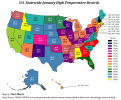
Record high temperatures for january in each state, with the year it happened...

1768780789832.png
 
  • Like
Reactions: tigerwillow1
Yes the climate changes.
It has ZERO to do with CO2 @400 ppm
That big fucking yellow thing in the sky might just have some affect

——/

Chris Martz

I'll explain this to ya like you're five. So, turn your ears on and put your five-finger sausage tuggers down.


It's my turn to talk. It's your turn to listen.

Let's continue. . .

The chart I plotted on the left shows the annual mean number of heatwave days (HWDs) per decade since the 1890s at all NOAA USHCNd stations with at least 100-years of daily temperature data. ️

. - .

Notice I put the text above in for you. I did that so you wouldn't miss it. I'm always looking out for you buddy o' pal. Don't sweat it.

Keep that in the back of your mind.

Oh, and silly me, I almost forgot. . .

Here, I defined a HWD the number of days per year at a given station with a daily maximum temperature that is equal to or exceeds the 90th percentile for that day relative to 1961-1990 climatology for, at a minimum, three consecutive days [as per World Meteorological Organization standards].

Was any of that confusing?

Are we on the same page?

I hope so. I'm on page 69. Isn't that nice?

Let's move on. . .

Now, the chart you linked to shows the annual average number of heatwaves per decade since the 1960s and it consists of data taken from 50 large U.S. cities, most of which are shown to be located in the eastern third of the CONUS and along the west coast.

Now, if you're smarter than a toothpick, there are two glaring problems with the data you presented. Let's see if you can figure it out all on your own first. This is a good mental exercise.

I smell smoke.

Were you thinking too hard again? ⚙️

Someone call the woo woo bus.

sirens

Let's put out that brain fart. Pshhhh. ‍

Alright. Well, you tried.

See, the two problems with your attempt of a rebuttal are:

➊ The data I presented begins in 1891. The data that you presented from the U.S. Global Change Research Program arbitrarily selects 1961 as the starting date. That's what you call cherry-picking.

➋ The data I presented was compiled from over 800 USHCNd stations with at least a century of data. The chart you presented was created using temperature data from 50 large U.S. cities that are compromised by urban heat island (UHI) effects which increasingly give artificially high readings.

No serious scientist would use the data you presented to make a point about climate [change].

But, since this was featured in the latest U.S. National Climate Assessment (NCA5), it is clear that some of the scientists or bureaucrats involved in writing this report were a few French fries short of a Happy Meal.

Hope that clarifies any confusion you might have.

View attachment 206942 View attachment 206941
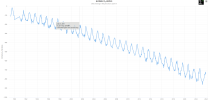
Actually its not co2, but the lack of O2 breakdown due to the oil industries killing of the fauna in the ocean with its pollution and oil spills. An international team of scientists have been tracking it since 1989. Historical Global Atmospheric Oxygen Levels Graph
Screenshot from 2026-01-18 22-20-54.png
 
Its 2026 - we're still talking about Climate Change? I thought we all moved on :rofl:
 
Poor Al Gore.
He may have to get a job