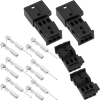
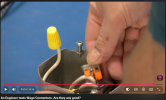
Anyone out there tried these Wago connectors?

I haven't watched the video so I may be wrong about this. I didn't see the image as the guy labeling those things. I saw it as the guy listing the labels that people have used to dismiss that particular thing.
Its click bait since it Isn’t clear. I saw it the opposite.
 
  • Haha
Reactions: CaptainCrunch
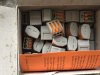
Have been using them since they first came to market and have the first generation of them:

The problem I ran into before the newer style came out was space. As others noted the ones you see in my attachment take up way more space than a marrette / wire nut.

Other problems I ran into was depending upon who the inspector was they would not approve them in the final.

That’s a combination of inspectors who are old school who simply can’t learn and accept new technology! With the advent of the (Wing Nut) added to the side of the wire nut it made turning the hardware easier with 100% encapsulation.

As with anything in the world there are tons of copy cat Wago nuts. Don’t purchase any of these fakes as they don’t meet any level of cUL requirements and testing.

There’s a few videos that show real world tests of fake vs real wago’s. Pull / retention strength is apparently lacking.

As is the amount of actual metal to pass the required current. Lastly, the dielectric insulation and durability of the plastic material.

Lots of the fake ones heat up quickly which breaks down the plastic and then results in an obvious hazard because the wire is now exposed!
 

Attachments

  • IMG_3884.jpeg
    IMG_3884.jpeg
    1.4 MB · Views: 19
  • IMG_3883.jpeg
    IMG_3883.jpeg
    3.1 MB · Views: 19
  • Like
Reactions: mat200
Not sure where to post this most appropriately, so here goes....

Anybody out there used these yet? I kept seeing them used inside cramped switch and outlet boxes in European and SA videos featuring Shelly Wi-Fi switches. My curiosity peaked so when I discovered they are UL-listed I ordered a 10-pack of the 3 position 221 series (221-413) from Amazon.

The UL approval, the built-in insulation strip length gauge, the allowance for stranded and solid conductors ranging from #28 to #14, provided test points and the clear plastic case for visual inspection convinced me to try them out.

I like the fact that, unlike a wire nut, you can remove and re-insert 1 of the 3 wires...that can be handy if you're replacing a failed or suspect component.

I don't plan to quit using wire nuts or to replace wire nuts with these but I do think they have a place and I hope to try these Wago's out soon.




I've used them on several houses doing lighting in ceilings. No problem at all, easy to use, been about 5 years, not had the first problem. They do make you wonder though, as the contacts just kind of "clip on". I'll keep using them, at least until I have a problem.......
 
As an Amazon Associate IPCamTalk earns from qualifying purchases.
  • Like
Reactions: TonyR and mat200
I've used them without any issues.

They also seem to be pretty standard in new lighting fixtures. In other words, it is common to get these types of connectors instead of the wire nuts if you buy a fixture that gets installed on a wall or ceiling. Wire nuts obviously work well, but they actually take some skill to use properly. As such, I think for the average home owner it is safer to use these type of connectors over wire nuts because there are a lot more ways you can "improperly" use wire nuts than these.
 
  • Like
Reactions: TonyR
I've used them without any issues.

They also seem to be pretty standard in new lighting fixtures. In other words, it is common to get these types of connectors instead of the wire nuts if you buy a fixture that gets installed on a wall or ceiling. Wire nuts obviously work well, but they actually take some skill to use properly. As such, I think for the average home owner it is safer to use these type of connectors over wire nuts because there are a lot more ways you can "improperly" use wire nuts than these.
I totally agree regarding wire nuts being "improperly" used, as you said. There is absolutely nothing wrong with wire nuts, "SkotchLoks", etc. BUT only if done right and too many folks do not do that, especially the homeowner that has not done hundreds of them and seen how they (and their technique) have performed over time.

I especially like how they the Wagos can better accommodate the splicing/mating of solid and stranded conductors. :cool:

As I stated in post #17, "The biggest problem with any twist-on wire connector (3M, Ideal, G-B, etc.) is how they are mis-applied and wrongly installed. The Wago is not immune from that but IMO you'd have to try harder to screw it up mainly because you can visibly see the wires AND they can re-seated if necessary.....some people, though, could screw up a one-car funeral procession. "
 
Last edited:
It’s total click bait to say wire nuts are a “hazard”. They are the gold standard of wire splicing and have been for decades. Anything can be a hazard if done incorrectly. I refuse to watch a video that is that misleading right from the thumbnail.
yeah! that right..
 
I totally agree regarding wire nuts being "improperly" used, as you said. There is absolutely nothing wrong with wire nuts, "SkotchLoks", etc. BUT only if done right and too many folks do not do that, especially the homeowner that has not done hundreds of them and seen how they (and their technique) have performed over time.

I especially like how they the Wagos can better accommodate the splicing/mating of solid and stranded conductors. :cool:

As I stated in post #17, "The biggest problem with any twist-on wire connector (3M, Ideal, G-B, etc.) is how they are mis-applied and wrongly installed. The Wago is not immune from that but IMO you'd have to try harder to screw it up mainly because you can visibly see the wires AND they can re-seated if necessary.....some people, though, could screw up a one-car funeral procession. "

You'd never get scotch locks past code in the UK. They're used only in 12 volt automotive applications.

Wago connectors are widely used over here and I've never heard of any issues.

Prior to Wago, electricians would use terminal blocks, not sure if that's what you call them in the US:

 
  • Like
Reactions: JDreaming and TonyR
Yes, they're called "terminal blocks" or "terminal strips" here as well. Another innovation that originated from Europe (Germany, IIRC) that I really, REALLY like is 35mm DIN rail and the numerous devices made to mount on it.....terminal blocks, relay bases, fuse blocks, Ethernet switches, power supplies, etc.

I spent the first 20 years of my working career having to mount the non-DIN rail versions of the aforementioned electrical/electronic devices onto cut, sanded and painted plywood backboards using screws and then wiring them up as per the schematic. When I began programming and implementing PLC's (Programmable Logic Controllers) about 1992 which were DIN rail mounted I discovered a whole new method and its supporting line of devices I could use in place of the old way. Just using the PLC alone would replace dozens of external, board-mounted relays, timers and their associated mounting bases and wiring but being able to snap on a device on the DIN rail was so nice, quick and clean. And the sheer size of the backboard, the number of external devices and the wiring labor required to accomplish the process would be reduced to about 1/4 the size by using the PLC and the other DIN-mounted control devices.

I recall a circa late 70's control panel for a H-U-G-E pair of Caterpillar 2,000Kw Diesel generators for a municipal passenger bus maintenance facility. The control panel and its board was almost the size of a 4' x 8' sheet of plywood (but metal) with all it's relays and timers to detect power problems with the incoming utility power ("mains") such as under- and over-voltage, missing phase (it was 480 volt, 3 phase), etc. and the duration of the fault. There were also relays/timers to begin cranking the engine, timing that process, detecting successful start, oil pressure then throttling up to the proper RPM, looking at its voltage output and frequency and if all good, perform the transfer. Then when the incoming utility power or missing phase was restored , more devices and timers would look at that and if conditions were right, transfer the load from the genset back to the utility. Then a cool-down timer would start and when timed out the engine(s) would shut down.

Sorry to get so long-winded but as I thought about the virtues of DIN-mounted devices I ran across all this stuff from 1973 to 2004 came back to me after making it though the many cobwebs and dust bunnies that now clog my cluttered brain. :cool:
 
Last edited:
I started using Wagos when upgrading my in wall automation switches. With every updated also replaced all wire nuts.

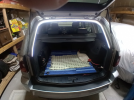
Just used Wagos here for my new SUV LED lighting. 18 guage wires. I also added new connectors for endeavor as I did not want to cut wires.

1765371473629.png

1765371605991.png
 
  • Like
Reactions: JDreaming and TonyR
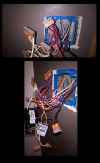
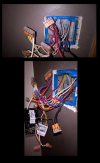
I had to install two automated switches in old house in a few rooms that had ceiling fans / lights / switched outlets and used Wago nuts. Still very tight and all of the boxes were metal so used a plastic mud plate to expand space. 1/2 of the duplex wall outlets were switched at the wall. Original wire nuts would not have worked with these in wall boxes. Lucky too that all of the duplex switches / mudplates cover 4 X 4 boxes in this home and last three homes.

Just redid my transfer switch wiring removing wire nuts and replacing them with Wagos.

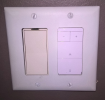
This is a UPB switch and a combo Tasmota ceiling fan / light switch. Way too many wires going through the box.

Current home is utilizing X10, UPB, Zigbee, ZWave and Tasmota (ESP WiFi firmware updated switches) Lucky here that all of the switch boxes have neutral leads.

1765373534558.png1765373597745.png
 

Attachments

  • 1765373558748.png
    1765373558748.png
    565.3 KB · Views: 6
Last edited:
  • Like
Reactions: TonyR and JDreaming
I had to install two automated switches in old house in a few rooms that had ceiling fans / lights / switched outlets and used Wago nuts. Still very tight and all of the boxes were metal so used a plastic mud plate to expand space. 1/2 of the duplex wall outlets were switched at the wall. Original wire nuts would not have worked with these in wall boxes. Lucky too that all of the duplex switches / mudplates cover 4 X 4 boxes in this home and last three homes.

Just redid my transfer switch wiring removing wire nuts and replacing them with Wagos.

This is a UPB switch and a combo Tasmota ceiling fan / light switch. Way too many wires going through the box.

Current home is utilizing X10, UPB, Zigbee, ZWave and Tasmota (ESP WiFi firmware updated switches) Lucky here that all of the switch boxes have neutral leads.

View attachment 234205View attachment 234207
Circa 2023 I had to replace a 17 year old failing combo fan speed and lighting dimmer switch in the master bedroom. The box is single gang and the dude that wired it up in 2006 must have left 4 feet of #14-2 with ground Romex wound in a coil and stuffed in the tiny box. I'm all about decent pigtails on receptacles, switches, dimmers, combo fan controls, etc. but any more a foot to 14" out of the box so you can get to the screws and wire nuts, etc. is just a PITA, in my opinion. I cut out over 2 feet and reconnected with new Ideal wire cnuts. If I had the Wagos at that time I would have used them. With 5 more combo fan-lighting controls that are now 2 years older I'll likely get a chance to do just that soon. And that's OK because since '06 I've gone with dimmable LED's in the fan lights and the old dimmers were not LED friendly; they'd flicker annoyingly unless set on full brilliance. :cool:
 
  • Like
Reactions: looney2ns