

AI Good and Bad
- Thread starter bigredfish
- Start date
You are using an out of date browser. It may not display this or other websites correctly.
You should upgrade or use an alternative browser.
You should upgrade or use an alternative browser.


Game over. Chinese AI companies are crushing prices and putting massive pressure on the American AI bubble.
The era of expensive GPUs, expensive data centers, and unlimited AI spending is coming to an end.
AI will keep growing. That doesn’t mean every AI stock will.
I expect many AI stocks to fall as much as 90% when this cycle turns.
$NVDA $AMD $SMCI $AVGO $ARM $TSM $MU $INTC $PLTR $ORCL $CRWV $META $MSFT$ GOOGL $AMZN
The era of expensive GPUs, expensive data centers, and unlimited AI spending is coming to an end.
AI will keep growing. That doesn’t mean every AI stock will.
I expect many AI stocks to fall as much as 90% when this cycle turns.
$NVDA $AMD $SMCI $AVGO $ARM $TSM $MU $INTC $PLTR $ORCL $CRWV $META $MSFT$ GOOGL $AMZN


I was waiting for that....Game over. Chinese AI companies are crushing prices and putting massive pressure on the American AI bubble.
The era of expensive GPUs, expensive data centers, and unlimited AI spending is coming to an end.
AI will keep growing. That doesn’t mean every AI stock will.
I expect many AI stocks to fall as much as 90% when this cycle turns.
$NVDA $AMD $SMCI $AVGO $ARM $TSM $MU $INTC $PLTR $ORCL $CRWV $META $MSFT$ GOOGL $AMZN
Great post-- There IS a ceiling, and China will find it and undercut everyone else by 20%, and a massive amount of your data will be manipulated by them, not that it matters much at this point. Feels like we're building towards something, but Is it the Matrix or Terminator?
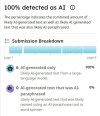
Meanwhile in my class.... <imagine the graphic of another 100% AI-generated paper discovered via AI-Detection that IPC forum error won't let me upload>

Arjun
IPCT Contributor

mat200
IPCT Contributor
- Jan 17, 2017
- 19,340
- 32,314
The Riskiest Moment of the AI Bubble
Hank Green
3.14M subscribers
Jun 9, 2026
NOTE! Since I recorded this video:
1. OpenAI has indeed made it’s first filing to go public, though how long from now that will happen is unclear.
2. SpaceX’s IPO numbers are in with 2X oversubscription, which is impressive in absolute numbers, but is also easy to over-read. That’s modest over-subscription for an IPO. But, as with anything Musk-shaped, it could go a lot of different ways!!
In this video, Hank Green discusses what he terms the 'riskiest moment' of the current AI bubble (4:19), characterized by a massive demand for new capital to fund AI development.
Hank Green
3.14M subscribers
Jun 9, 2026
NOTE! Since I recorded this video:
1. OpenAI has indeed made it’s first filing to go public, though how long from now that will happen is unclear.
2. SpaceX’s IPO numbers are in with 2X oversubscription, which is impressive in absolute numbers, but is also easy to over-read. That’s modest over-subscription for an IPO. But, as with anything Musk-shaped, it could go a lot of different ways!!
In this video, Hank Green discusses what he terms the 'riskiest moment' of the current AI bubble (4:19), characterized by a massive demand for new capital to fund AI development.
Key Takeaways:
- Massive New Capital Requirement: Major companies like Google ($85 billion), SpaceX ($75 billion), and firms like Anthropic and OpenAI are seeking to raise hundreds of billions of dollars in new capital (0:00, 1:41, 5:17). Unlike typical stock trading where existing shares change hands, these offerings represent a need for new money to enter the market (2:01, 3:55).
- The AI Bubble: While the underlying technology may be transformative—similar to railroads or the internet—the author argues that investors are currently paying 'too much too soon' (8:46). The risk lies in whether there is enough actual liquidity to satisfy these massive demands (6:06).
- Google's Strategy: Hank suggests that Google's push to raise capital now is a savvy move to secure safety and capital while the bubble is still inflated, potentially absorbing demand that would have gone to competitors (7:28).
- The 'Real' Test: This period marks a shift from a market driven by 'belief' to one that requires 'real cash' (4:27). The author warns that if investor confidence shifts to caution, the sheer cost of maintaining these high valuations could cause the bubble to face significant challenges (9:30).
Conclusion:
Hank concludes by expressing his personal preference for a low-risk, long-term investment strategy—which he likens to a Honda Civic—rather than betting on the volatile fluctuations of the current AI hype cycle (12:02).Google's Strategy: Hank suggests that Google's push to raise capital now is a savvy move to secure safety and capital while the bubble is still inflated, potentially absorbing demand that would have gone to competitors (7:28).
It's like a Black Friday door buster sale offering cheap money with the major AI companies as customers...



mat200
IPCT Contributor
- Jan 17, 2017
- 19,340
- 32,314
It's like a Black Friday door buster sale offering cheap money with the major AI companies as customers...
View attachment 244745
nice visual
mat200
IPCT Contributor
- Jan 17, 2017
- 19,340
- 32,314
Louis Rossman to sue Samsung ..
Samsung's 990 Pro SSD warranty policy is a scam; I'm taking them to court.
Louis Rossmann
In this video, creator Louis Rossmann details his negative experience with Samsung's warranty support and his decision to initiate a lawsuit against the company.
The Conflict:
Samsung's 990 Pro SSD warranty policy is a scam; I'm taking them to court.
Louis Rossmann
In this video, creator Louis Rossmann details his negative experience with Samsung's warranty support and his decision to initiate a lawsuit against the company.
The Conflict:
- SSD Failure: Rossmann's Samsung 990 Pro 4TB SSD failed while in a RAID 1 array, despite being well-cooled with heatsinks and fans (0:07-0:28).
- The RMA Process: After contacting Samsung, he faced frustrations with their support system, including tickets being closed prematurely (2:31-3:01) and receiving his drive back with a "test pass" status, despite it clearly failing performance tests in his professional data recovery lab (3:19-5:06).
- The "Shortage" Claim: Samsung claimed the drive was fine and later stated they could not provide a replacement due to a shortage of memory products (9:26-9:42). Rossmann highlights that the same drives are readily available for purchase on Samsung’s store for nearly triple the price he originally paid (9:45-11:36).
- Legal Action: Rossmann sent a statutory notice stating he will file a lawsuit in the Justice Court of Travis County, Texas if he does not receive a replacement within 60 days (7:06-7:16, 13:13-13:20).
- Principal Argument: He argues that Samsung is prioritizing sales to AI data centers over honoring existing warranty obligations to consumers (10:14-10:50).
- Motivation: He emphasizes that the lawsuit is not just about the drive, but about setting a precedent that it should be more expensive for corporations to act unethically than to fulfill their warranty commitments (13:20-13:46, 15:20-15:58).
Reality starting to creep into the AI chat.
This is actually pretty big
$157B OpenAI valuation couldn't convince a bank to back a $6B loan.
That gap isn't happenstance. It's a market telling you the number and reality aren't aligned.
This is actually pretty big
$157B OpenAI valuation couldn't convince a bank to back a $6B loan.
That gap isn't happenstance. It's a market telling you the number and reality aren't aligned.
mat200
IPCT Contributor
- Jan 17, 2017
- 19,340
- 32,314
I admit to being fairly stupid about the bigger AI picture, but what I see tells me it won’t end well.
Here is the US .gov issuing an order that certain “models” of the most popular and most advanced AI, Anthropic’s “Claude” , can no longer be distributed.
Apparently they are afraid it’s too powerful and in the “wrong” hands would be detrimental to the US
I have a feeling it’s more that it will be too competitive to the “chosen/approved” models by companies like SPACEX (an AI company not a spaceship company as you’ve been led to believe) and AMAZON (an AI company not a retailer as you’ve been led to believe)
Funny how the announcement came the same day as SPACEX IPO….
Here is the US .gov issuing an order that certain “models” of the most popular and most advanced AI, Anthropic’s “Claude” , can no longer be distributed.
Apparently they are afraid it’s too powerful and in the “wrong” hands would be detrimental to the US
I have a feeling it’s more that it will be too competitive to the “chosen/approved” models by companies like SPACEX (an AI company not a spaceship company as you’ve been led to believe) and AMAZON (an AI company not a retailer as you’ve been led to believe)
Funny how the announcement came the same day as SPACEX IPO….
mat200
IPCT Contributor
- Jan 17, 2017
- 19,340
- 32,314
I admit to being fairly stupid about the bigger AI picture, but what I see tells me it won’t end well.
Here is the US .gov issuing an order that certain “models” of the most popular and most advanced AI, Anthropic’s “Claude” , can no longer be distributed.
Apparently they are afraid it’s too powerful and in the “wrong” hands would be detrimental to the US
I have a feeling it’s more that it will be too competitive to the “chosen/approved” models by companies like SPACEX (an AI company not a spaceship company as you’ve been led to believe) and AMAZON (an AI company not a retailer as you’ve been led to believe)
Funny how the announcement came the same day as SPACEX IPO….
Massive race between China and USA in the AI Manhattan Project.
reports of
China is not allowing AI Researchers leave China without getting permission.
China has iirc 2x the STEM majors vs USA, so USA has a solid competitor.
Previously Chinese AI companies used Anthropic and other USA AI models to improve theirs and make the Chinese AI models run better and cheaper ( deep seek for example )
China can easily setup data centers without local NIMBY issues
China can easily setup coal power plants ( China has a ton of coal, and coal power is cheap and fast to setup )
USA needs to find ways to leverage a win vs China.
This is NOT going to be easy, and many of US retirement funds are being dumped into this over priced game ..
I am expecting China to become the cheap AI provider to much of the world at this rate.
USA tech industry is in for a major challenge.
mat200
IPCT Contributor
- Jan 17, 2017
- 19,340
- 32,314
Here's more on the US Government moving to block foreign nationals from accessing Mythos / Fable 5 models from Anthropic
AI News & Strategy Daily | Nate B Jones
This video discusses the unprecedented move by the US government to force Anthropic to take its most advanced AI models, Fable 5 and Mythos 5, offline (0:00 - 0:17). The creator, Nate B. Jones, argues that this event marks a shift in how frontier AI models are treated—transitioning from standard software products to controlled national security assets (0:54 - 1:02).
Key takeaways from the video:
AI News & Strategy Daily | Nate B Jones
This video discusses the unprecedented move by the US government to force Anthropic to take its most advanced AI models, Fable 5 and Mythos 5, offline (0:00 - 0:17). The creator, Nate B. Jones, argues that this event marks a shift in how frontier AI models are treated—transitioning from standard software products to controlled national security assets (0:54 - 1:02).
Key takeaways from the video:
- The Safety Layer: While reports suggest the intervention stemmed from a jailbreak pathway, the creator notes that the lack of a transparent, technical public process sets a concerning precedent for future governance (1:14 - 3:06).
- The "Foreign National" Restriction: The order restricts access for foreign nationals, even those within the United States. Because of the global nature of modern AI operations, this effectively acts as an off-switch for the model rather than a surgical restriction (3:07 - 4:49).
- The Business Reality: The creator believes the situation is temporary and will likely be resolved quickly through negotiated access, similar to previous collaborations between Anthropic and the government on cybersecurity initiatives (4:50 - 5:29).
- A New Era for AI Operators: The video emphasizes that model access is now a policy surface. Operators should move away from building critical workflows dependent on a single model and instead keep alternative solutions ready, as frontier access is no longer guaranteed on yesterday's terms (6:34 - 7:55).
mat200
IPCT Contributor
- Jan 17, 2017
- 19,340
- 32,314
"If this is so dangerous, why are you giving Americans access to it .. if the idea is safety then no one should have access to it .. "
Arjun
IPCT Contributor
mat200
IPCT Contributor
- Jan 17, 2017
- 19,340
- 32,314
"The window has closed"
This video explores a shift in the AI industry narrative following recent IPOs from companies like SpaceX, OpenAI, and Anthropic (0:00-0:14). While the physical infrastructure and model locations remain unchanged, the speaker discusses how the public transition of these firms has normalized artificial intelligence as a mainstream, publicly traded industry rather than a secretive, hypothetical pursuit (2:06-2:43).
Key themes include:
This video explores a shift in the AI industry narrative following recent IPOs from companies like SpaceX, OpenAI, and Anthropic (0:00-0:14). While the physical infrastructure and model locations remain unchanged, the speaker discusses how the public transition of these firms has normalized artificial intelligence as a mainstream, publicly traded industry rather than a secretive, hypothetical pursuit (2:06-2:43).
Key themes include:
- The Ecosystem Argument: The creator references an article by Satya Nadella, which argues that simply selling AI "tokens" is insufficient. Success requires building an ecosystem and learning loops within organizations (0:46-0:58, 2:43-3:00).
- The Market Economics of Tokens: The speaker draws an analogy between AI tokens and selling potatoes; as the cost per token drops, businesses must shift from selling the commodity itself to selling the tools that produce it or focusing on the value added (e.g., cancer research, software generation) (3:00-4:51).
- The Global AI Race: The video highlights an article by Andrew Curran, who posits that the "window has closed" for nations trying to catch up in AI dominance, citing technologies like Fable or Mythos as tipping points that will accelerate the compounding advantage of current leaders (1:13-1:56).
mat200
IPCT Contributor
- Jan 17, 2017
- 19,340
- 32,314
This is insane when you think of it ..
The Trump admin basically forced anthropic to sideline the top AI talent from working on USA AI ... something stinks here
Guessing this could be part of the department of defense getting pissed off at Anthropic ..
Several key Anthropic personnel and researchers are foreign-born, though Anthropic has historically declined to comment on the exact citizenship status of individual employees. [1]
Because the Commerce Department's export control directive explicitly bars all non-U.S. citizens—including permanent residents and those on work visas (like H-1B or EB-1)—from touching Fable 5 and Mythos 5, media and industry analysts have pointed to three prominent figures at Anthropic who are directly impacted by this geographical restriction: [1, 2, 3, 4, 5]
1. Andrej Karpathy (Lead AI Researcher) [1]
2. Chris Olah (Co-Founder & Lead Researcher) [1]
The Trump admin basically forced anthropic to sideline the top AI talent from working on USA AI ... something stinks here
Guessing this could be part of the department of defense getting pissed off at Anthropic ..
Several key Anthropic personnel and researchers are foreign-born, though Anthropic has historically declined to comment on the exact citizenship status of individual employees. [1]
Because the Commerce Department's export control directive explicitly bars all non-U.S. citizens—including permanent residents and those on work visas (like H-1B or EB-1)—from touching Fable 5 and Mythos 5, media and industry analysts have pointed to three prominent figures at Anthropic who are directly impacted by this geographical restriction: [1, 2, 3, 4, 5]
1. Andrej Karpathy (Lead AI Researcher) [1]
- Background: Born in Slovakia and raised in Canada, Karpathy is one of the world's most recognizable AI researchers, famed for co-founding OpenAI and leading Tesla’s Autopilot team. [1]
- Impact: He recently joined Anthropic to work on core frontier research. Tech analysts quickly noted that because he operates under a visa or non-citizen status (such as an EB-1 extraordinary ability visa), he is legally locked out from accessing or patching the very models his team is tasked with advancing. [1, 2, 3]
2. Chris Olah (Co-Founder & Lead Researcher) [1]
- Background: Born in Canada, Olah is a core co-founder of Anthropic and an influential pioneer in AI Mechanistic Interpretability—the science of peering inside neural networks to understand how they "think" and why they jailbreak. [1]
- Impact: His inability to access the model weights creates a severe bottleneck, as his team’s interpretive research is exactly what Anthropic needs to systematically diagnose and fix the safety bypass flagged by the government.
