Haven't read their whole analysis but the theory seems to be spreading among many. And thats assuming that AI CapEx vs revenues doesn't crater first.
I dont think it takes into account geopolitical events and we see even today that money is flooding into Emerging economies ex-US. That has been the hot ticket for a month.
Add to that the erratic start/stop policies of the
Epstein er Trump Administration, and its easy to see how volatility could increase greatly.
I dunno? I don't think it will be one One Thing, it usually isnt. But we are already by many measures entering a Recession, some segments of the population are feeling it others not so much.
Regardless, I still think we see a 20%-30% correction that will take years to recover at best. Thats why I keep most of my money in fixed 4-5% solid investments and only play with a small pile in the
casino market, more as a hobby.
It all just reminds me of 2000 or 2008
There’s another AI-doom post doing the rounds. This time, the S&P 500 dives nearly 40%.
A booming AI economy may be very bad for the broader economy, according to Citrini Research

www.marketwatch.com
What if artificial intelligence actually meets or exceeds the hype around it, but that turns out to be very bearish for stocks? That’s the scenario posed by a new piece of commentary doing the rounds over the weekend, which has caused quite a flutter online.
The piece, co-authored by Citrini Research and guest Alap Shah, managing partner at Lotus Technology Management, is written as a lookback from June 2028, when the unemployment rate has just risen to 10.2% and the S&P 500 is down 38% from its Oct. 2026 highs around 8,000.
The first step on this dystopian journey will be familiar to us in 2026: the dislocation caused by agentic AI. Software-as-a -service companies will lose sales as client demand falls. “The company that sold workflow automation was being disrupted by better workflow automation, and its response was to cut headcount and use the savings to fund the very technology disrupting it,” projects the report.
By early 2027, AI usage will become the default among consumers and businesses. AI agents will be on smartphones, and they won’t wait to be asked, working with the users preferences to deliver a continuous optimization process. This removes friction in consumption, stripping out inertia in subscriptions, constantly finding the cheapest and best option, reducing companies margins and thus profits.
For example: “Habitual app loyalty, the entire basis of the [delivery] business model, simply didn’t exist for a machine,” says Citrini.
This disruption will extend to payments, done over stabelcoins instead of a provider like Mastercard
This is all sector risk. But then the argument morphs into systemic risk as AI proves different to previous technological advances. “AI is now a general intelligence that improves at the very tasks humans would redeploy to. Displaced coders cannot simply move to ‘AI management’ because AI is already capable of that,” says the Citrini report.
White collar job hiring will begin to collapse, they say. In their scenario, the bond market will notice this — white-collar workers represented 50% of employment and drove roughly 75% of discretionary consumer spending — and yields will start to fall.
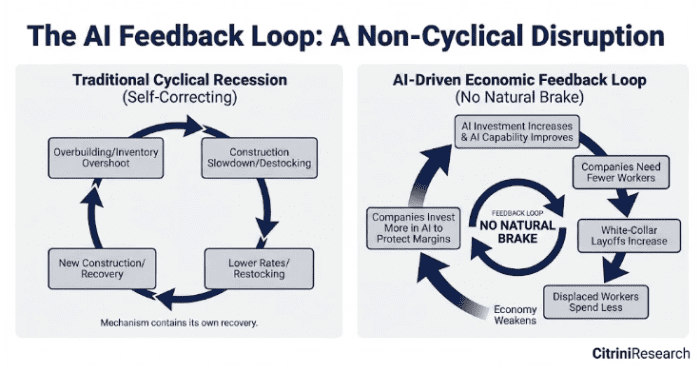
In a normal recession, the cause eventually self-corrects. But this downturn’s cause will not be cyclical. As companies lay off workers, they’ll use the savings to buy more AI, and therefore cut even more workers. With fewer workers, there’ll be less consumption. It is a feedback loop with no natural brake, they add.
And so the AI economy will continue to improve while the broader economy deteriorates. India’s services exports will be particularly vulnerable to the agentic revolution, Citrini suggests.
In this scenario, things get bad in February 2027 — initial jobless claims spike to 487,000, the S&P 500 drops over 6%, and by the second quarter of 2027 there’s a recession.
And then “the daisy chain of correlated bets” will start to fracture. Private credit companies will have to sharply mark down their software investments. Moody’s will downgrade billions of dollars those debts in April 2027. Software backed loans start defaulting in the third quarter of 2027. Insurers with links to private credit are forced by regulators to raise capital or sell assets.
Citrini goes into great detail about these linkages, which are worth reading here. For example, they see house prices in San Francisco tumbling 11%. The government will be ideologically hamstrung in its response, reluctant to levy taxes on the AI economy to support displaced workers. “While the politicians bicker, the social fabric is fraying faster than the legislative process can move,” says Citrini.
Citrini is at pains to point out at the start of their note that this scenario is not a prediction. “This isn’t bear porn or AI doomer fan-fiction. The sole intent of this piece is modeling a scenario that’s been relatively underexplored,” they say.
The piece generated a wave of reaction. One founder, John Loeber, penned
his own essay in opposition, arguing that as AI challenges white-collar labor, governments will fund large-scale physical re-industrialization.











 . Who knows with the volatility we're seeing.


 . It looks so obvious that this house of cards we call the economy is destined to fall. I have an issue-age policy, so these increases are not connected to me getting older.

