


Its in the latest AiModelPack download.Hmm...where did you find that one?
Blue Iris Version 6.0.1.24 Now Supports Custom Models
- Thread starter MikeLud1
- Start date
You are using an out of date browser. It may not display this or other websites correctly.
You should upgrade or use an alternative browser.
You should upgrade or use an alternative browser.


Ah...maybe run animal along with yolov10sBut, I don't think either Yolo includes "deer" (my nemesis). IPCam-Combined (and animal) does...
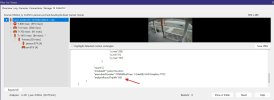

Wow, it must have been added in the last few days, as it wasn't part of the last round of additions and changes (to the aimodelpack) on 01/24/2026. Thanks, testing now.Its in the latest AiModelPack download.
You may, but it is not recommended at this time and they are not included the the model pack.Why not use yolo11 ?
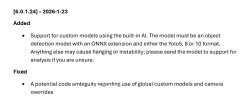
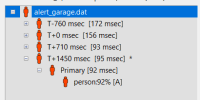
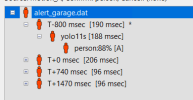
Like @Tinman pointed out it's not supported as a primary model. I've tried both and yolo10 just works better.Why not use yolo11
Yolo10
Yolo11

CrazyAsYou
Getting comfortable
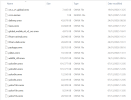
As of today the following models are part of
CrazyAsYou
Getting comfortable
When comparing
YOLOv10 vs. YOLOv8 for CCTV footage, the choice depends on whether your priority is raw speed and efficiency (YOLOv10) or high detection accuracy, particularly for small or distant objects (YOLOv8).
YOLOv10 is faster and more efficient due to its NMS-free (Non-Maximum Suppression) design, making it ideal for edge devices and real-time, low-latency applications, while YOLOv8 is a more mature and versatile, robust model.
Summary Comparison for CCTV
Key Takeaways for CCTV Surveillance
YOLOv10 vs. YOLOv8 for CCTV footage, the choice depends on whether your priority is raw speed and efficiency (YOLOv10) or high detection accuracy, particularly for small or distant objects (YOLOv8).
YOLOv10 is faster and more efficient due to its NMS-free (Non-Maximum Suppression) design, making it ideal for edge devices and real-time, low-latency applications, while YOLOv8 is a more mature and versatile, robust model.
Summary Comparison for CCTV
| Feature | YOLOv8 | YOLOv10 |
|---|---|---|
| Best For | Reliability, Small Object Detection | Real-time Edge Deployment, High FPS |
| NMS | Uses NMS (Post-processing) | NMS-free (End-to-End) |
| Small Objects | Superior performance | Can struggle at far distances |
| Speed | Very Fast | Generally faster (lower latency) |
| Ecosystem | Very Mature (Robust) | Newer (Research-focused) |
Key Takeaways for CCTV Surveillance
- YOLOv10 (End-to-End Efficiency): Because it eliminates the need for Non-Maximum Suppression (NMS), YOLOv10 is often faster at inference, which is a major advantage for real-time monitoring on resource-constrained hardware like NVIDIA Jetson boards. It is designed for maximum efficiency.
- YOLOv8 (Robustness & Accuracy): For typical security, where cameras are high up and objects (people, vehicles) are small or far away, YOLOv8 generally performs better. It is more reliable at detecting smaller objects in crowded or complex scenes.
- Vehicle/Object Detection: While YOLOv10 performs well in vehicle detection, some tests show that YOLOv8 has a slight advantage in car detection, while YOLOv10 might be better at detecting smaller, more complex vehicles like bicycles.
- Low Light/Blurry Conditions: In cases of blurry video or low-light, YOLOv11 and YOLOv8 are often found to be more stable than YOLOv10.
- Use YOLOv8 if your main concern is detecting every possible object (high recall), including small, distant, or partially occluded objects, or if you need to use additional features like pose estimation or segmentation.
- Use YOLOv10 if your primary constraint is limited hardware capacity and you need the lowest possible latency and highest FPS, and if the objects are generally closer to the camera.
I agree with the helpful comparison between the YOLOv8 and YOLOv10 for the most part, except in my case YOLOv10 seems to run slightly slower (on an Intel i5-8500 with integrated graphics 630). Distant/small object detection seems a bit worse with v10, often taking longer to detect until they (cars/people) got closer in.
My 2 cents...
My 2 cents...
The_Penguin
Pulling my weight
Is the model used (v6 vs v10 for example) dependent on the AI engine, or are all the differences in the models themselves?
The_Penguin
Pulling my weight
I hope some versioning gets added soon so we don't have to download regularly and see if there's anything new.As of today the following models are part of

adventuredphoto
Young grasshopper
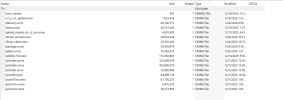
I had a platework pcs.onnx included. Any idea what that is now?
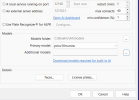
Also you don't include alps,license-plate in the additional models anymore?
Also you don't include alps,license-plate in the additional models anymore?

I do not see platework pcs.onnx in the current Blue Iris built-in AI model download. What are you trying to do with the AII had a platework pcs.onnx included. Any idea what that is now?
Also you don't include alps,license-plate in the additional models anymore?
View attachment 237359
adventuredphoto
Young grasshopper
Was included in mine for some reason. No idea why..I do not see platework pcs.onnx in the current Blue Iris built-in AI model download. What are you trying to do with the AI
View attachment 237360
Also for additional models now you can’t include license-plate or alpr.
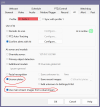
If you want to have the AI read the license plates use the below settings, you do not need to include any modelWas included in mine for some reason. No idea why..
Also for additional models now you can’t include license-plate or alpr.
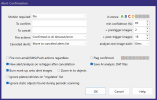
Haven't had a chance to set it up to do anything useful, but I upgraded to 6.0.1.30, and used one of the YOLO models from the modelpack, and was able to get a sensible analysis (albeit very slow on CPU, in the region of 10,000msec. Perhaps I will try on GPU).
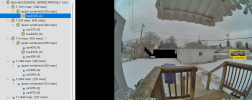


Turn off periodic AI scan. Out of curiosity are you seeing the same results using the built-in models (yolo8 or yolo10)?Is there a way to keep moving objects from being identified as "Occupied"?
Last edited:
Periodic AI scan is off. Using the built in AI in Blue Iris using Yolov8s.onnx.Turn off periodic AI scan. Out of curiosity are you seeing the same results using the built-in models (yolo8 or yolo10)?
I will try something. Back in the day, when I was involved with software development, we would run into things we called tri-state, where a setting would be in an undefined state.
I will try to check the periodic AI scan, save, then uncheck the periodic AI scan, and see if that helps.
If not, I will send an email to Ken. I don't really know if this decision is made by the AI module, or the Blue Iris program itself.