Best sensors for low light?

Jan 22, 2026
11
7
TX
I'm building a new system and am wondering what recommendations are for getting the best sensors (within a reasonable budget, $150-$300).

I've got an old gaming PC that's doing my AI crunching, so I don't need anything smart, so would like the money to all go toward optics and sensor.

Would love recommendations for turret POE cams and LPR cams!

LogicAndLumber
 
Welcome!

Without knowing what your goals of the camera is, this thread is used as the go to for the new person here outlining the commonly recommended cameras (along with Amazon links) based on distance to IDENTIFY that represent the overall best value/best bang for the buck in terms of price and performance day and night. It might be a 2MP camera in some instances. Many here feel 4MP is the current sweet spot for these cameras.

The Importance of Focal Length over MP in camera selection

And coupled with that thread is this great thread which will show why all of the same 2.8 or 3.6mm cameras is the wrong choice (these are the common focal lengths consumer brands sell):

i-want-2-8mm-cameras-everywhere-to-see-everything-this-is-why-you-need-specific-fovs-with-purposeful-focal-lengths.70053/

We would encourage you to look at those threads in detail.

It will probably raise more questions than answers LOL.
 
Welcome!

Without knowing what your goals of the camera is, this thread is used as the go to for the new person here outlining the commonly recommended cameras (along with Amazon links) based on distance to IDENTIFY that represent the overall best value/best bang for the buck in terms of price and performance day and night. It might be a 2MP camera in some instances. Many here feel 4MP is the current sweet spot for these cameras.

The Importance of Focal Length over MP in camera selection

And coupled with that thread is this great thread which will show why all of the same 2.8 or 3.6mm cameras is the wrong choice (these are the common focal lengths consumer brands sell):

i-want-2-8mm-cameras-everywhere-to-see-everything-this-is-why-you-need-specific-fovs-with-purposeful-focal-lengths.70053/

We would encourage you to look at those threads in detail.

It will probably raise more questions than answers LOL.
That's great, thank you for the reference! I am ok with questions haha. I'm excited to tear into this.

My goal is to monitor my property (2.5 acres but only about 1 acre for surveillance) accurately day and night. I've got some squatters next door that are problematic.
 
  • Like
Reactions: Flintstone61
The number of cameras can add up quick depending on your needs lol.

One camera cannot be the be all, see all.

Folks here have over 25 cameras for typical quarter acre lots lol
 
The number of cameras can add up quick depending on your needs lol.

One camera cannot be the be all, see all.

Folks here have over 25 cameras for typical quarter acre lots lol
No doubt that there's no end to the surveilling you can do haha.

My dad and brother just purchased Ubiquiti systems and are clowning me because they "got the professional equipment" and I'm putting together my own. TBH I'm the only one of us that really needs a system at all, but in any case, I want to be more educated than them on the matter and build a smarter system.

I'm using frigate and home assistant to run everything (and eventually I'll have some cool smart home integration with cameras).
 
No doubt that there's no end to the surveilling you can do haha.

My dad and brother just purchased Ubiquiti systems and are clowning me because they "got the professional equipment" and I'm putting together my own. TBH I'm the only one of us that really needs a system at all, but in any case, I want to be more educated than them on the matter and build a smarter system.

I'm using frigate and home assistant to run everything (and eventually I'll have some cool smart home integration with cameras).
The cams we suggest will run circles around the Ubiquity over priced equipment.
 
As a general rule, the larger the actual sensor size, the better the low/no light performance. In addition, the higher the resolution a camera has, the WORSE the low/no light performance is going to be (more pixels means smaller pixels which can't absorb as much light as larger pixels).

So, the "best" low/no light sensor is going to the the largest sensor with the lowest resolution that fits in your budget. Of course everything is relative. You have to have enough resolution to be functional (a 1" sensor with 10 total pixels isn't going to provide any usable footage. Even if it could capture data in complete darkness without IR), but too much resolution hampers performance.

Unfortunately the general public thinks the opposite - that high resolution (ie 4k or better) is better for cameras. As such, manufactures tend to produce high resolution cameras because they will sell better than lower resolution cameras.
 
As a general rule, the larger the actual sensor size, the better the low/no light performance. In addition, the higher the resolution a camera has, the WORSE the low/no light performance is going to be (more pixels means smaller pixels which can't absorb as much light as larger pixels).

So, the "best" low/no light sensor is going to the the largest sensor with the lowest resolution that fits in your budget. Of course everything is relative. You have to have enough resolution to be functional (a 1" sensor with 10 total pixels isn't going to provide any usable footage. Even if it could capture data in complete darkness without IR), but too much resolution hampers performance.

Unfortunately the general public thinks the opposite - that high resolution (ie 4k or better) is better for cameras. As such, manufactures tend to produce high resolution cameras because they will sell better than lower resolution cameras.
Heck yeah, that's cool to understand. How do people in this space talk about the range at which an object is identifiable and what resolution you need to accomplish that? It seems like there'd be some easy "don't go past this resolution" line you could draw for most practical applications.
 
Heck yeah, that's cool to understand. How do people in this space talk about the range at which an object is identifiable and what resolution you need to accomplish that? It seems like there'd be some easy "don't go past this resolution" line you could draw for most practical applications.

With the right focal length, 2MP is more than sufficient.

Most here feel that 4MP is the sweet spot.

8MP suffers from not having varifocals, so the effective distance of a 2.8 or 3.6mm 8MP is roughly the same as a 4MP.

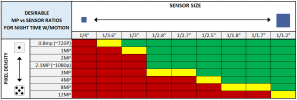
Most go by this chart. Anything in green is what you want:

1769273948060.png


That is why in The Importance of Focal Length over MP in camera selection thread I posted above, it has the cameras we commonly recommend along with the suggested distance for IDENTIFY for each camera model.

DORI (Detect, Observe, Recognize, Identify) numbers are provided for each camera in their specs.

DORI is a nice tool in the tool box, but these are under ideal situations and real world experiences of DORI is that those numbers are established by the manufacturer and are based on best case scenarios like an object not moving and ideal light conditions.

Real world you should cut them in half during daytime and cut that half in half or more at night time.

Our long time resident camera expert Wildcat ran the Dahua 4K/X 8MP 1/1.2" sensor thru the paces. Keep in mind this 4K/X camera is incredible.

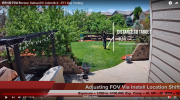
He had the 3.6mm version and here is the screenshot from 40 feet in the ideal daylight and standing still, which based on DORI numbers is the supposed IDENTIFY distance for this camera with the 3.6mm lens and I think most of would agree that this is not IDENTIFY quality, even if digitally zoomed in:

1769273861992.png


I have the 4K/X and 4K/T and they are incredible cameras, but I wouldn't use it for IDENTIFY past 15-20 feet, or half of what the DORI number is.

 
With the right focal length, 2MP is more than sufficient.

Most here feel that 4MP is the sweet spot.

8MP suffers from not having varifocals, so the effective distance of a 2.8 or 3.6mm 8MP is roughly the same as a 4MP.

Most go by this chart. Anything in green is what you want:

View attachment 236864


That is why in The Importance of Focal Length over MP in camera selection thread I posted above, it has the cameras we commonly recommend along with the suggested distance for IDENTIFY for each camera model.

DORI (Detect, Observe, Recognize, Identify) numbers are provided for each camera in their specs.

DORI is a nice tool in the tool box, but these are under ideal situations and real world experiences of DORI is that those numbers are established by the manufacturer and are based on best case scenarios like an object not moving and ideal light conditions.

Real world you should cut them in half during daytime and cut that half in half or more at night time.

Our long time resident camera expert Wildcat ran the Dahua 4K/X 8MP 1/1.2" sensor thru the paces. Keep in mind this 4K/X camera is incredible.

He had the 3.6mm version and here is the screenshot from 40 feet in the ideal daylight and standing still, which based on DORI numbers is the supposed IDENTIFY distance for this camera with the 3.6mm lens and I think most of would agree that this is not IDENTIFY quality, even if digitally zoomed in:

View attachment 236862


I have the 4K/X and 4K/T and they are incredible cameras, but I wouldn't use it for IDENTIFY past 15-20 feet, or half of what the DORI number is.

Edit: thank you for all this info, it's fantastic! That chart is exactly what I needed.

Can you tell me more about the language you're using like IDENTIFY, what other functions you'd expect cameras to serve, and how those functions get laid out and serve to monitor a space?