Your liberty : OS level age ( and soon ID ) verification ! 2026+

mat200

IPCT Contributor
Jan 17, 2017
18,745
31,367
Recent news : "All Operating Systems must do age verification" laws as of today :
Brazil (Law 15.211) : requirements in effect Match 17, 2026
California USA ( AB-1043) : Signed into law. Requirements in effect Jan 1, 2027
Colorado (SB26-51) : passed Senate on Match 3, 2026
NY (S8102A): In Senate Committee

The Lunduke Journal First report on Colorado Democrats :


Next Day Reported on California law ( passed and signed by Governor Newsom ) :


1772734961240.png

even FreeDOS which does not have account holders !
 
Who's behind the California Age Verification Law?

Mar 6, 2026
A shallow dive into the background and lobbying around California AB-1043: Age verification signals: software applications and online services.


1772870172649.png
 
Linux Distros Are Fighting Back Against California's Surveillance Law
Ton Does Linux and More!

Mar 6, 2026 TonDoesLinux podcast
California just passed a law that could fundamentally change how we use every operating system, including our beloved Linux distros. The Digital Age Assurance Act (AB 1043), effective in 2027, mandates OS-level age checks. What does this mean for the future of open-source, and more importantly, for your personal privacy? We're diving deep into the law, the massive privacy risks, the backlash from the open-source community, and what you can do about it. This isn't just about California; it's a battle for the future of the free and open internet.


1772912751850.png
 
There are so many ways to circumvent the age verification unless they go to something like fingerprint or iris scanning, with everyone who uses a computer having to register their fingerprint or iris scan to the government. Or maybe everybody get an implanted chip. This feels to me like it's right on the path of how a civilization falls.
 
  • Like
Reactions: mat200
There are so many ways to circumvent the age verification unless they go to something like fingerprint or iris scanning, with everyone who uses a computer having to register their fingerprint or iris scan to the government. Or maybe everybody get an implanted chip. This feels to me like it's right on the path of how a civilization falls.

Blue Iris uses a user account system for access, separate from the Windows login.

Question, how old is the BlueIris user on a Windows PC ?
 
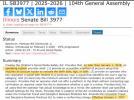
Illinois jumping on the Age Verification on the OS bandwagon ..

1773076568837.png
1773076587309.png
1773076630229.png

 
I put 99 years old and got prompted that I was too old to use a computer
 
  • Haha
Reactions: mat200 and johnfitz
Proper research Journalists still attempting to figure out the smoking gun behind this ..

recently a article came out claiming META is behind this to push the cost of age verification to the OS vendors instead of META and other Websites

Is Meta Behind the Age Verification Laws?
The Lunduke Journal

 
Brazilian Age Verification law is now in effect


ArchLinux32.org - has notification for Brazilians that they are unable to provide services to Brazil ( for download ) ..

"As a community-run Free and Open Source Software ( FOSS ) project, we do not have the legal infrastructure or financial resources to implement the "auditable age assurance" and "identity verification" mechanisms .. "

Brazil's Age Verification Law is in Effect, Ubuntu Being Monitored for Compliance

The Lunduke Journal

Mar 17, 2026
Brazil monitoring 37 companies, including Canonical, Valve, & more. System76 bans users for asking about age verification. Rockstar Games &
Arch Linux 32 restrict access in Brazil.

 
MicroSoft OS .. Age Verification code getting added ..

 
New Federal Law to Require Age Verification on All Operating Systems
The Lunduke Journal
1776290378813.png


Apr 15, 2026
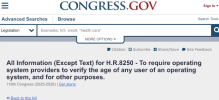
H.R. 8250 ("To require operating system providers to verity the age of any user of an operating system, and for other purposes.") has been introduced in the U.S. Congress.


This video from The Lunduke Journal discusses the introduction of H.R. 8250, a new federal bill in the United States that would mandate full age verification for all users at the operating system (OS) level (0:00-1:28).

Key takeaways from the video:

  • Nature of the Law: Unlike age attestation (simply claiming an age) or estimation (using AI to guess age), this bill seeks to require rigorous identity verification (e.g., driver's licenses or official documents) before a user can access their operating system (0:20-0:50, 4:03-4:45).
  • Potential Motivations: The host argues that this push is likely an attempt by large web platforms (like Meta/Facebook) to shift the legal burden and financial cost of age verification from websites to operating system developers like Apple, Google, and various Linux distributions (12:26-15:36).
  • Impact on Open Source: Many operating systems are already beginning to implement age-related functionality to comply with state-level laws (like those in California), which the host warns makes it significantly easier for them to adopt the more stringent federal requirements of H.R. 8250 (6:44-8:21).
  • Public and Political Response: The host notes that while some politicians seem to be "true believers" who think these measures will protect children, the legislation faces significant technical and privacy hurdles. The recent withdrawal of a similar law in Michigan serves as a primary example of how public pressure and education can influence legislators (18:38-21:04).
Call to Action:The host encourages viewers to reach out to their congressional representatives to express concerns regarding the privacy, feasibility, and overreach issues posed by implementing age verification within core operating systems (23:35-24:46).


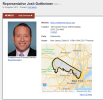
H.R. 8250 is a federal bill introduced on April 13, 2026, that requires operating system providers to verify the age of any user of an operating system.

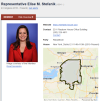
Introduced by Rep. Elise Stefanik and Rep. Josh Gottheimer, the measure was referred to the House Committee on Energy and Commerce and is currently in its early stages. While the full text of the bill remains unavailable, it aims to shift age verification responsibilities from individual apps and websites directly to OS developers like Apple and Google, mandating verification during device setup rather than relying on self-reported data.

Privacy advocates and the public have raised significant concerns regarding the legislation, citing potential violations of:

  • Fourth Amendment rights due to broad, warrantless identity collection.
  • First Amendment protections by potentially chilling anonymous speech.
  • Equal Access issues that could disproportionately impact vulnerable populations lacking government ID.
  • Data Privacy risks associated with creating a centralized system of sensitive personal information.
It is important to distinguish this 2026 proposal from previous iterations of H.R. 8250, such as the 2022 Copyright Clause Restoration Act and the 2024 Clean Air in the Cloud Act, which addressed copyright terms and EPA air quality systems respectively.

1776290530217.png