AI Good and Bad

LLM .. give you some statistical mean of code .. and that mean is horse shit code .. good code is significantly above mean / average code ..

 
Fucking grifter

The entire AI hoopla is a fucking joke. A scam


Too Big to fail already ? OpenAI ?

Honestly I was very disappointed that Micron dropped their Crucial Line, one of the better brands imho - should have kept it going even if reduced products
 
AI produced code .. still a liability .. will have a lot of hacked code soon when everyone uses AI slope code

 
She looks like she is trying to take a sh!t

 
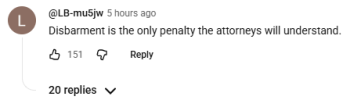
Attorneys Keep Ignoring The Dangers of AI in Court
Steve Lehto

Apr 6, 2026
Despite well-publicized cases of lawyers being punished, lawyers continue filing pleadings with courts that are filled with AI-hallucinations.


In this video, attorney Steve Lehto discusses the ongoing and problematic trend of lawyers using generative AI to create court documents, despite high-profile sanctions and public warnings.

Key Takeaways:

  • The Responsibility of the Signature: Lehto emphasizes that when an attorney signs a pleading, they are legally vouching for the accuracy of its contents (0:08-0:21). The defense that "AI made it up" is not a valid excuse because the lawyer is ultimately responsible for what they file (0:59-1:07, 11:12-11:18).
  • Rising Sanctions: The use of AI-generated content—specifically "hallucinated" or fictitious case citations—has led to a surge in court sanctions (1:27-1:33). While initial fines were smaller, such as $3,000, courts are increasingly issuing harsher penalties, including a record-setting $19,000 sanction in Oregon (1:42-1:50, 2:42-2:52).
  • The Problem of Integration: As AI tools become standard in legal software, some courts have introduced "labeling" requirements to identify AI-assisted filings (4:43-4:56). However, experts argue this may soon become ineffective as AI becomes ubiquitous in all software (5:34-6:13).
  • Systemic Risks: Lehto warns that high-pressure environments, such as large law firms with intense billable hour requirements, tempt lawyers to use AI to speed up tasks without proper verification (6:43-7:26, 8:12-8:20). He argues that regardless of the technology, attorneys must maintain a "natural thinking time" to scrutinize their work before filing (8:20-8:32).
Ultimately, Lehto stresses that there is no excuse for filing hallucination-riddled briefs, and attorneys who fail to read what they sign face serious professional risks, including having their filings struck by the court (13:10-13:40).


1775504284286.png
 
  • Like
Reactions: bigredfish