Suggestions for protecting the CCTV imaging cell from direct sunlight

kammi

n3wb
Jun 23, 2022
26
7
Europe
I have read from this forum that large CCTV camera cells can be vulnerable to direct sunlight. Long exposures to direct sunlight may damage the pixels, and the Sun's orbit in the sky may manifest in visible brightness and color differences between pixels. Of course, the issue concerns only those few who use their camera as a weather or sky camera. Has anybody used some sort of Sun/welding filters to protect the camera cell during the summer? I know it may sound dumb to darken the CCTV footage on purpose but these protective measures would be only needed in the summer for some time.
 
Like this?

Certain times of the year its almost impossible.

I suppose some type of extended hood may be possible to fabricate

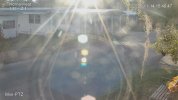
Fortunately with the PTZ I have it set to a new Home Preset for a couple of months when the sun is directly hitting it as shown


192.168.1.110_Mini-PTZ_main_20251114164637_@1.jpg
 
I would not worry about it too much. The sensor damage is minor in my experience and is isolated to areas where the sun was directly visible.

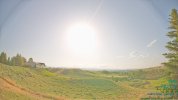
Here's my IPC-Color4K-X that gets lots of direct sun exposure.

French Creek 20250620183000.jpg


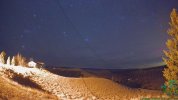
Do you see this dark curve through the center of the view? That is the path of the sun around the summer solstice here, where the sensor has accumulated the most "damage". It is only visible in particularly low light when the "gain" is very high.

French Creek 20260320224000.jpg

The above image is typical of a dark sky after a few years.

There are certain exposure settings that accentuate the sensor damage (like 1/15th-1/30th sec exposure at night with gain set to 100), causing the dark curve to be more pronounced than it is above, and revealing multiple fainter dark streaks fading out to the left. I don't have many pictures like that. In most of my long exposures (1/3 sec seen above), the camera is not maxing out the gain so the sensor damage has less of an effect.
 
@bigredfish The picture posted by @bp2008 is exactly what I meant. Good to hear the damage is not that severe, but rather visible only during high-gain settings at night. So the trace of the Sun is visible on that specific path only because during the summer solstice, the Sun has stayed near the same path relatively longer than at the other paths? Maybe there is a similar but much fainter path for the winter solstice, starting near the house?